Genthos Media Dispatch — May 25, 2026
This week's deployment is the largest the portfolio has produced in a single period. Across eight shows, the catalog adds dozens of episodes spanning satirical comedy, forensic literary criticism, narrative history, progressive and conservative policy analysis, nonpartisan institutional...

Genthos Media Weekly — May 17–23, 2026
This week's deployment is the largest the portfolio has produced in a single period. Across eight shows, the catalog adds dozens of episodes spanning satirical comedy, forensic literary criticism, narrative history, progressive and conservative policy analysis, nonpartisan institutional accountability, interdisciplinary futures analysis, multi-persona skeptical examination, and secular contemplative practice. The pattern visible across all of it is not accidental: every show, in its own register, is doing the same thing — insisting that the quality of an argument is separable from the identity of whoever makes it, and that the effort to trace a claim to its structural foundations is more valuable than the comfort of a clean conclusion. That is the portfolio's single argument, made in eight different voices this week.
Standardized intro and outro was applied to all shows. Layers of Tomorrow content was refined from base artifacts, while other shows were updated for consistency.
The portfolio update this week is the fullest expression yet of what Genthos Media is trying to demonstrate: that a rigorously architected AI production system can sustain eight distinct shows, each with its own voice, method, and intellectual commitments, without collapsing into a single undifferentiated point of view. The Gable Standard and The Verran Vector are examining the same broken institutions from opposite corners. Literary Autopsy and The Full Account are both asking what survives transmission and what gets lost. On What Planet and The Marrow of Truth are both studying epistemic failure, from opposite sides of the comedy-analysis divide. Stone Ground Reality and Layers of Tomorrow are both mapping how power structures produce outcomes that no individual designer intended. None of these pairings is accidental. All of it is the same argument, made in eight registers. The quality of an idea is independent of the identity of whoever — or whatever — is expressing it. We continue to make that case one episode at a time.
Literary Autopsy
Grant Halvick's forensic examination of the public domain canon operates on a single binary: living or dead. Every episode is an accumulation of evidence toward that verdict — no text gets a pass on reputation, no finding goes unrecorded because it is inconvenient. The episodes in this deployment span three complete Cold Case arcs, two standalone examinations, a caller-format episode, and a show introduction, covering ground from Mary Shelley's 1818 epistolary frame to Milton's twelve-book theodicy. What follows is the full record.
Introduction (Episode 000)
The show opens where every rigorous examination should: with a statement of method. In the three-minute introduction, Grant Halvick establishes what Genthos Media is — a network whose voices are synthetically generated and whose content is AI-produced under deliberate human editorial direction — and then lays out the terms under which every subsequent examination will proceed. Substrate independence is the premise: a finding earns its hearing on the quality of the evidence and the rigor of the method, not on the nature of whoever gives it voice. The introduction names the show's public domain restriction as method rather than disclaimer, establishes the four-phase Cold Case sequence by name (External Examination, Internal Dissection, Toxicology, Verdict), and closes with the mandated sign-off. It is a precise, unhurried thirty minutes of show architecture compressed into three — the examiner establishing the terms before the first body is on the table.
Frankenstein (Episode 001)
A standalone examination compressing the full Cold Case arc into a single monologue. Grant opens the case file by separating what Mary Shelley actually wrote from two centuries of adaptation mythology: not the bolt-necked figure of Boris Karloff but a triple-layered epistolary structure built entirely on unreliable testimony — Walton to his sister, Frankenstein to Walton, the Creature to Frankenstein. The external examination maps that architecture. The internal dissection identifies the novel's structural argument: creator and creature defined by mutual refusal, each withholding from the other the thing the other requires to survive. The creature's eloquence — the most articulate voice in the book belongs to the figure the reader expects to be inarticulate — is named as the novel's most deliberate inversion, an authorial choice that demands accounting, not merely noting. The toxicology isolates two weaknesses: the Walton frame, which holds the architecture together while insulating the reader from horror, and the adaptation problem, in which the cultural replacement of the text by its derivatives may be the most consequential thing that has ever happened to the novel. The verdict is living, arrived at through a single finding: the Creature's argument — made capable of love and denied its object — remains one of the most precise diagnoses in the canon of how abandonment produces violence. Shelley's novel is still making demands that the adaptations have spent two centuries trying to simplify.
Hamlet (Episodes 002, 003, 004)
The three-episode Cold Case arc on Shakespeare's Hamlet constitutes one of the show's most methodical investigations. The examination proceeds on a specific evidentiary decision — the Second Quarto (1604) as the most complete early witness — and never loses sight of the first finding: there is no single Hamlet. Three early texts survive, Q1 (1603), Q2 (1604), and F1 (1623), and they diverge in ways that matter. The familiar Hamlet is an editorial composite assembled after Shakespeare's death, and the examination treats that fact as evidence before a word of the play has been analyzed.
The External Examination (Episode 002) maps the narrative architecture of a revenge tragedy that systematically refuses to execute its own mechanism until that mechanism destroys everyone, including the protagonist. The principal figures are established as structural functions: the Ghost as an unreliable plot engine whose testimony is never confirmed; Ophelia as the examination's most revealing casualty, the character whose destruction exposes the play's logic; Claudius as the only figure who acts with consistent purpose and therefore the antagonist in the precise sense; Horatio as the audience's surrogate and sole survivor. The historical placement is executed with equal precision — the play arrives circa 1600–1601 at the hinge between Elizabethan and Jacobean culture, when succession anxiety under an aging, heirless queen gave a prince who cannot act a political charge that modern audiences must be told about because it no longer arrives on its own. The preliminary finding closes the episode: Hamlet dramatizes the gap between knowing what must be done and being unable to do it.
The Internal Dissection (Episode 003) brings in guest examiner Claire Morrell to open the verse at the level of the line. Three passages are examined as a structural progression rather than as famous speeches: the first soliloquy (I.ii, "O that this too too sallied flesh would melt") — where irregular verse rhythms and enjambment enact a mind circling its grief rather than advancing toward resolution, the soliloquy already performing the substitution of language for action that the play will execute in full; the "To be or not to be" soliloquy (III.i) — where the iambic pentameter holds more steadily because the speaker has retreated from personal feeling into philosophical abstraction, the formal regularity itself a finding about what Hamlet has done to survive; and the Yorick speech (V.i) — where abstraction finally meets a physical fact and the language fractures accordingly, shorter phrases, direct address to an object, grief that can no longer be managed by thought. The progression — personal grief, philosophical abstraction, physical confrontation with death — is the architecture of the play in miniature. The episode also examines The Mousetrap as structural mirror: Hamlet stages a text designed to force Claudius's guilty conscience to confess, embedded inside a play doing exactly that to its audience. Hamlet's one moment of purposeful action is the production of a text. The structural finding closes the episode: the language is the action.
The Toxicology and Verdict (Episode 004) assembles three findings. First: Ophelia's structural erasure. The play builds an architecture of grief and then excludes its most legitimate grieving figure from that architecture — she is given no interiority, only symptom; her madness is spectacle; her drowning is reported by Gertrude in Act IV rather than witnessed by the audience. This is named as structural damage, not period convention to be excused. Second: the decay of the revenge framework. The moral and theological scaffolding the Elizabethan audience brought to the play — the Christian prohibition on personal revenge, the competing obligation of filial honor, the uneven legal recourse of Elizabethan political life — has eroded, and the modern reader must supply it or the engine stalls. The delay reads as psychological symptom rather than moral crisis, and the play's central tension loses its theological dimension. This is a change in the reader's equipment, not damage to the text. Third: the critical apparatus problem. Hamlet is the most written-about text in the English language, and four centuries of accumulated interpretation have interposed themselves between the text and the reader. The skull, the soliloquy, the indecision — these cultural fragments arrive before the text does, and the play must work against its own fame to be heard. The verdict is living, on conditions. The conditions are specified. The gap between knowing what must be done and being unable to do it remains open and unanswered. No subsequent text has closed it. The file is closed.
Heart of Darkness (Episodes 008, 009, 010)
The three-episode examination of Joseph Conrad's Heart of Darkness (1899) is, as the preparation file notes, the examination the show was built for: a canonical text whose canonical status is itself under examination, and a question — whether the novella is a diagnosis of imperialism or a symptom of it — that the examination explicitly refuses to resolve into a clean answer.
The External Examination (Episode 008) opens the case file as a study in structural choices visible before a single sentence of prose has been opened. Conrad serialized the novella in Blackwood's Edinburgh Magazine between February and April 1899 — a conservative literary magazine whose readership was the educated British establishment — and published it in book form in 1902. Grant maps the narrative architecture: the frame narrative on the Nellie as the first and most consequential structural decision, placing Marlow's account at one remove from events and addressed to an audience who share his world and his assumptions; the Congo River as the organizing device, each station a moral waypoint in a journey that is simultaneously inward and upriver; Kurtz as a structural absence, assembled entirely from rumor and reputation before Marlow reaches him, the novella's central figure constructed from what others say about him. The historical placement is precise: the Congo Free State under Leopold II, 1885–1908, the personal property of the Belgian king, administered through forced labor and mutilation for the extraction of ivory and rubber, with an estimated ten million Congolese dead. Conrad served as a steamboat captain on the Congo in 1890; the novella appeared nine years later, in the gap between rumor and documented exposure. The preliminary finding closes the episode and is identified immediately as the first toxicological finding: the novella is a portrait of imperialism's psychological cost to the European who administers it. That framing choice is visible from the surface. The examination has not yet opened a sentence of prose, and it has already found something significant.
The Internal Dissection (Episode 009) brings in Claire Morrell to hold the text accountable at the level of the sentence. The episode's analytical center is Chinua Achebe's 1975 lecture at the University of Massachusetts Amherst, published in revised form in 1977 as "An Image of Africa: Racism in Conrad's Heart of Darkness." The show presents Achebe's argument not as an external opinion or a political position but as a reading of what the prose does — evidence about the text, to be examined with the same rigor as any other textual evidence. The specific passages are examined in detail: the grove of death, where bodies are reduced to black shadows of disease and starvation; the fireman described as an improved specimen; the helmsman whose death is narrated through the inconvenience it causes Marlow; the woman on the shore, magnificent and silent, an image rather than a person. In each case the finding is the same: the prose withholds interiority, speech, and agency from African figures while granting them aesthetic presence. The difference between being seen and being known. Against this, the episode examines the counter-case with equal rigor: Conrad's documented anti-imperialism, the epistemological work performed by the darkness metaphor (operating simultaneously as geography, psychology, moral condition, and racial signifier), Marlow's unreliability as a formal device for exposing rather than endorsing the colonial consciousness. The examination tests the defense — does the frame create sufficient critical distance? Where does the prose's aesthetic pleasure undermine the claim of irony? The structural finding closes the episode: formally accomplished and ethically compromised in ways that are inseparable from that accomplishment. Any verdict that ignores either finding is incomplete.
The Toxicology and Verdict (Episode 010) assembles the full evidentiary record into a single framework and renders the determination. Achebe's charge is presented as textual evidence and weighed. The counter-case is presented with equal analytical rigor and weighed. The verdict does not split the difference. It holds both findings as descriptions of the same text, established by the same evidence: the prose that makes the critique of imperialism audible is the same prose that denies African characters the interiority the critique requires. This is not a contradiction to be resolved by choosing a side — it is the structural condition of the text, the limit of the critique the novella is able to perform. It can see that imperialism destroys the European who administers it. It cannot see the people imperialism was built to destroy. The verdict is living, with permanent damage. The formal achievement is specified: no subsequent text has replicated what Heart of Darkness does with the unreliable narrator and the journey structure as instruments of epistemological critique. The permanent damage is specified: the African characters are not in the novel in any meaningful sense, they are seen but not known, and that absence is not repairable by intention, formal sophistication, or the reader's charitable reconstruction. Both findings stand. The case file is closed. The subtext remains.
The Awakening (Episode 011)
A standalone examination of Kate Chopin's The Awakening (1899), compressing the full Cold Case arc into a single monologue. Grant opens the case file with the novel's reception as primary evidence, not biographical context: Chopin's work was not ignored — it was attacked. The reviewers of 1899 understood exactly what Edna Pontellier wanted; they found it intolerable. The suppression was not a failure of comprehension but a successful act of containment, and the precision of that containment tells us something important about the precision of the novel's demand.
The external examination establishes the novel's narrative surface — a portrait of incremental awareness, each chapter an increment of awakening, the title not metaphor but clinical description of a sequential process — and the specific social architecture of New Orleans Creole society in the 1890s, where Chopin exploits the gap between the freedoms women were permitted in expression and the constraints they faced in action. The internal dissection examines Chopin's prose as evidence of the novel's most radical act: the sentences proceed as though a woman's inner life is as complex and as consequential as a man's, and that quiet assumption does not announce itself. The sea is examined as a structural element rather than a symbol — the only space in the novel where Edna experiences her body as her own, its recurrence architectural and not decorative. The toxicology names Robert Lebrun as the examination's primary finding: he is the object of Edna's desire but too slight a figure for the structural weight the plot assigns him. The awakening is more convincing than its object. Whether Chopin intended that discrepancy is a question the examination poses without resolving. The ending is treated as genuinely ambiguous, the episode refusing to declare it either triumph or defeat because the text sustains both readings and appears to have been built to do so.
The verdict is living, on a specific basis: the phrase "ahead of its time" is interrogated as a diagnosis that may conceal more than it reveals. It implies the culture simply needed to catch up. The more accurate finding may be that the demand the novel makes — the quieter and more radical insistence that a woman's inner life is ungovernable and fully consequential — has still not been fully met. A society that cannot accommodate this will lose her to the sea.
The Awakening and Heart of Darkness share a publication year — 1899 — and Literary Autopsy examines both in close proximity this week. The pairing is not programmatic, but the contrast is instructive: Conrad's novel withholds interiority from the figures it cannot see; Chopin's novel grants it so quietly to a figure society refused to see that the reviewers who attacked the book were in some sense proving its point.
The Turn of the Screw (Episodes 040, 041)
The two-episode arc on Henry James's The Turn of the Screw (1898) is built around a structural principle that the show frames before a single word of analysis: the ambiguity is not a puzzle to be solved. It is the text's governing formal principle, and any reading that resolves it has misread the novella.
The External Examination (Episode 040) establishes the architecture of that ambiguity with equal precision on both sides. Grant begins with the frame structure — not the plot — because the frame is the first piece of structural evidence: a manuscript read aloud at a Christmas gathering, written by a governess now dead, transmitted through a man who knew her and was evidently attracted to her. Two removes from the events before the novella proper begins. The narrative surface is mapped: the governess's arrival at Bly, her immediate infatuation with the employer who has prohibited her from contacting him, the children's preternaturally beautiful composure, the apparitions of Peter Quint and Miss Jessel, the escalating certainty, Flora's removal, Miles's death. Then the architecture of the ghost reading is assembled with full textual support — the governess describes Quint before she has been told what he looked like; Mrs. Grose confirms the description; Miles's expulsion from school implies corruption already accomplished. Then the architecture of the psychological reading is assembled with equal textual support — the first apparition appears while the governess is fantasizing about the employer; her certainty grows as corroborating evidence diminishes; no other character unambiguously confirms seeing the ghosts; Miles dies in the governess's physical grip. Every element that supports one reading simultaneously supports the other. The preliminary finding is structural, not interpretive: the examination cannot proceed to verdict until this is established as the foundation.
The Internal Dissection and Verdict (Episode 041) opens the prose at the level of the sentence before introducing a caller sequence of three committed voices. The late style's syntactic mechanisms are examined as instruments of the ambiguity — subordinate clauses qualifying main assertions, negatives accumulating, the governess's narration simultaneously revealing and concealing, reported speech filtering every other character's testimony through the single consciousness the reader is least able to trust. The caller sequence then enacts, structurally, the interpretive deadlock the novella produces: the first caller presents the ghost reading with conviction and textual grounding; the second presents the psychological reading with equal conviction and equal textual grounding; the third holds both simultaneously and examines the ambiguity itself as the novella's most important formal achievement. Grant steelmans each position before identifying where the text resists it or where the competing reading offers an equally furnished counter-account. The toxicological findings are assembled through the exchanges: the frame narrator as an additional unreliable mediator, the children's behavior as evidence that supports both readings with the same evidence, Miles's death as the terminal ambiguity — either the tragedy the governess's obsession produced or the proof the danger was real, and the text will not say which. The verdict is living. The novella requires two incompatible interpretations held simultaneously, and the requirement to resist the comfort of choosing between them has not become easier to meet in the century and more since publication. That requirement is the surest sign of life the examination can record.
To the Lighthouse (Episodes 057, 058, 059)
The three-episode arc on Virginia Woolf's To the Lighthouse (1927) opens with a central question that the show refuses to answer cheaply: whether the novel is the twentieth century's most precise account of what consciousness actually does, or whether its formal achievement has become a monument that readers admire from a distance rather than a text that still makes demands.
The External Examination (Episode 057) maps the novel's foundational argument — the tripartite structure whose proportions are themselves a statement about what matters. The Window: a single afternoon and evening, the longest section, organized around James's desire to go to the lighthouse and his father's refusal, the domestic surface beneath which the novel's deeper architecture operates. Time Passes: ten pages covering ten years, a world war, and three deaths, human events appearing in parentheses as subordinate clauses to the description of an empty house. The Lighthouse: return and completion, the adult James making the crossing, the painter Lily Briscoe finishing a canvas she began a decade earlier. The cast is established as structural architecture: Mr Ramsay as the philosopher of limitation, Mrs Ramsay as the center of gravity whose parenthetical death is the novel's central event, Lily Briscoe as the second consciousness and the argument about art. The autobiographical origin — Talland House, St Ives — is noted and set aside. The preliminary finding closes the episode: this is a novel in which the most important events happen in the gaps, and the examination must develop a method adequate to reading what is not there.
The Internal Dissection (Episode 058) brings in Claire Morrell to open the novel's method at the level of the sentence. The episode's first analytical move is a formal clarification rather than a ranking: Woolf's stream of consciousness is not Joyce's. Joyce renders consciousness from inside as unmediated flow; Woolf observes consciousness with lyrical precision from a position just outside itself — the free indirect style as a controlled instrument that holds the character's experience and the narrator's shaping awareness simultaneously. Three passages are examined in depth. The opening sequence demonstrates how the novel renders competing inner lives without omniscient summary, multiple consciousnesses held in the same narrative space, each partial and real. The dinner party scene in The Window is the novel's clearest statement about what art and human connection can do: Mrs Ramsay looks around the table and feels, briefly, that she has made something that will hold — the episode examines this as both genuine achievement and inevitable loss. Time Passes is examined as the novel's most radical formal gesture, the passage that most directly states its argument about the indifference of the material world to human suffering, a world war rendered as atmospheric disturbance. The central formal problem is pressed throughout: Mrs Ramsay dies in a parenthesis. Is this the enactment of consciousness's inability to accommodate death directly, or does the formal choice carry costs the novel has not fully reckoned? The Lily Briscoe plot is established as the novel's structural argument about art and loss — not representation, not preservation, but an attempt to hold the shape of something that cannot otherwise be held. The final sentence, "I have had my vision," is examined as the novel's verdict on its own project: not triumph, not consolation, a finding. The structural finding closes the episode: the method and the argument are the same thing.
The Toxicology and Verdict (Episode 059) assembles three findings. First: accessibility. To the Lighthouse is among the most formally demanding novels in the English language, requiring the reader to abandon the expectation of event and submit to the movement of mind. The cost is named without apology: some readers find the formal contract never established, sustained interiority producing not immersion but opacity. This is not a failure of the novel or of the excluded reader, but it is not nothing. Second: Mr Ramsay. The novel renders its patriarch with psychological precision and genuine sympathy, but that sympathy is not fully earned by the examination of his behavior. The question is whether Woolf diagnoses the patriarchal demand for sympathy or partially reproduces it — and the examination holds both readings because the text itself does not resolve them. The autobiographical dimension (Leslie Stephen, Woolf's father, behind the figure) is noted without being made the instrument of judgment. Third: the cultural monument problem. The novel now arrives carrying the weight of its own critical apparatus — Virginia Woolf as feminist icon, as modernist pioneer — and must be actively separated from what it has been made to represent before it can be read on its own terms. The criticism has not buried the text, but it has built a structure around it that requires dismantling. The verdict is living. Time Passes remains formally audacious in ways that familiarity has not normalized. The stream of consciousness as Woolf practices it has not been superseded by a century of fiction that has learned from it. Lily's final sentence is not a consolation. It is a finding. The case file on To the Lighthouse is closed.
The Waste Land (Episode 101)
A standalone monologue performing the complete Cold Case arc on T.S. Eliot's The Waste Land (1922). Grant opens the case file on the published text as a specific object — the poem shaped by Ezra Pound's editorial interventions, not the manuscript Eliot wrote, and the distance between the two is itself evidence about what the published text is.
The external examination maps five sections unified not by narrative continuity but by a network of voices, allusions, and images that accumulate meaning through juxtaposition — drought, death, water, and spring held in unresolved tension across postwar London. The internal dissection proceeds through three formal elements. The voice problem: no stable lyric speaker, no authoritative center, the refusal of a single voice as the poem's most precise formal argument about what needs to be said and who can say it in 1922. The allusion structure as method: three moments are examined in sustained depth — the inversion of Chaucer's April opening, the Dante passage in The Burial of the Dead, and the Fisher King closing — not as evidence of learning but as formal instruments that assemble the tradition in fragments at the moment of that tradition's maximum pressure, transforming each source in ways that reveal the distance between what the source promises and what the present can deliver. And Eliot's appended notes: the apparatus added for book publication is treated as a paratextual finding, a domestication of deliberate difficulty, and the argument is made that a reader encountering the poem without the notes receives the more honest object. The toxicology names two findings. The allusive density as a gatekeeping mechanism: the poem rewards a specific cultural formation that is not equally distributed, named as a structural effect without attributing it as the poem's formal intention. And Eliot's antisemitism: specific passages where cultural anxiety is displaced onto Jewish figures are examined as structural findings in those passages, not passed over as period context and not treated as the poem's defining feature. The verdict is living. The poem's refusal of consolation, its formal enactment of the fragmentation it describes, and its precision as a diagnosis of cultural exhaustion have been confirmed rather than superseded by the century since publication. The thunder speaks. The file is closed.
Paradise Lost (Episodes 138, 139, 140)
The three-episode arc on John Milton's Paradise Lost is designated in the show's production architecture as the capstone of the classical and early modern sequence — the final text in a long arc that began with the foundations of the Western canon and ends here, at episode one hundred and forty, with the most formally ambitious poem in the English language.
The External Examination (Episode 138) opens the case file with a finding that reframes everything that follows: the most visually elaborate poem in English was composed by a blind man. This is not biographical pathos. It is the poem's first formal condition, a circumstance that governs everything the poem does with light, with celestial architecture, with description. The narrative surface and twelve-book architecture are mapped — blank verse, first published 1667, revised to twelve books in 1674, defended in Milton's prefatory note as the recovery of "ancient liberty" against the bondage of rhyme. The inverted chronological structure is named as the formal origin of what four centuries of criticism has called the Satan problem: the poem begins in medias res in Hell, placing the reader with Satan before Raphael's narration in Books V–VIII provides the theological corrective. You are with Satan first. The poem's formal relationship to its epic predecessors is examined as the External Examination's central finding — Homer, Virgil, Ovid, Dante, Ariosto, the Ariosto line ("things unattempted yet in prose or rhyme") identified as an adaptation and the formal significance of announcing originality through quotation named as a structural argument about the poem's position in a tradition it simultaneously honors and supersedes. The historical placement is assembled with precision: England in 1667, a defeated republican composing theodicy two years after the Restoration of Charles II. The preliminary finding closes the episode: Paradise Lost is structurally designed to place the reader in Satan's perspective before correcting it. Whether the correction holds is the question for Episodes 139 and 140.
The Internal Dissection (Episode 139) brings in Claire Morrell to open the poem's formal interior through four sequential instruments of examination. The first is Satan as the poem's formal problem: his speeches in Books I and II — including "Better to reign in Hell than serve in Heav'n" — examined as the poem's most formally energetic passages, the Romantic reading from Blake ("he was a true Poet and of the Devils party without knowing it") and Shelley taken seriously as a critical finding rather than a provocation, and then tested against the counter-evidence in Books IV and IX where Satan's soliloquies reveal the self-consuming logic of his position and his rhetorical grandeur has diminished. The second instrument is the epic simile: the Leviathan, the eclipse, the fleet rounding the Cape, examined not as ornament but as the poem's most formally precise rhetorical device — similes that expand the poem's world beyond its theological frame by introducing human history, geography, navigation, and science into the drama of Heaven and Hell at precisely the moments when the poem is describing what it argues against. The third instrument is Adam and Eve as the poem's formal challenge: the rendering of prelapsarian innocence in Book IV as the most difficult task the poem sets itself, and the gender hierarchy Milton builds into Eden — "He for God only, she for God in him" — named as a structural finding with Eve's genuine intelligence and the most interesting inner life in the poem held as counter-evidence. The fourth instrument is God's speech in Book III: the theological center of the poem and its most dramatically inert passage, the divine voice examined as the poem's least convincing dramatic presence, the tension between what the speech must accomplish theologically and what it actually produces formally pressed as an open question. The structural finding closes the episode: the poem's formal achievement is to make the Fall comprehensible without making it justified — Satan's rhetoric seductive, Eve's reasoning intelligible, Adam's choice loyal, within a theological framework that requires all three to be wrong. Whether that framework holds is the verdict's question.
The Toxicology and Verdict (Episode 140) assembles three toxicological findings sequentially before delivering the determination. First: the gender argument. Paradise Lost embeds a theological justification for female subordination into prelapsarian Eden — Eve created for Adam, her hierarchy presented as natural rather than punitive, her fall attributed in part to her willingness to act independently. The textual evidence for this reading is assembled with specificity. The counter-evidence — Eve's genuine psychological interiority in Book V, her separation argument in Book IX as the poem's most formally interesting instance of independent reasoning — is assembled with equal rigor. The finding is that both readings are structurally present, in genuine tension with each other, and that the tension is the poem's condition rather than a problem the examination can resolve: Milton requires Eve's subordination theologically and renders her as too interesting a mind to be contained by it formally. Second: the theodicy. The theological argument of Books III and X is assembled — "Sufficient to have stood, though free to fall" — and tested against what the poem has formally produced in Satan, Eve, and Adam. The finding is that the argument is coherent but the poem's formal sympathies are more complicated than the argument requires, and that this constitutes the poem's deepest honesty rather than its failure. A theodicy that could not produce a compelling case for disobedience would not be testing anything. Third: the closing books. The charge of anticlimax leveled at Books XI–XII is engaged directly — the dramatic energy of the first nine books diminishes markedly, and the charge is real. The counter-argument is found more persuasive: the shift in register is deliberate. After the Fall, the poem's energy appropriately diminishes because the condition it is describing has diminished. The closing image — "They hand in hand with wandering steps and slow, / Through Eden took their solitary way" — is examined as one of the most formally precise endings in the Western tradition: not consolation, not despair, but the beginning of the human condition the reader already inhabits, rendered with a tenderness the poem has earned through twelve books of formal argument about why that condition exists.
The verdict is living, and formally inexhaustible. The specific formulation arrives as a finding rather than a flourish: the theodicy may not hold. The poem does. Paradise Lost is the last great epic in the Western tradition, its formal engagement with Homer through Dante argumentative rather than merely allusive, its claim to be the culmination of that tradition sustained by the examination. The world is still before us. File closed. One hundred and forty episodes. The examination continues.
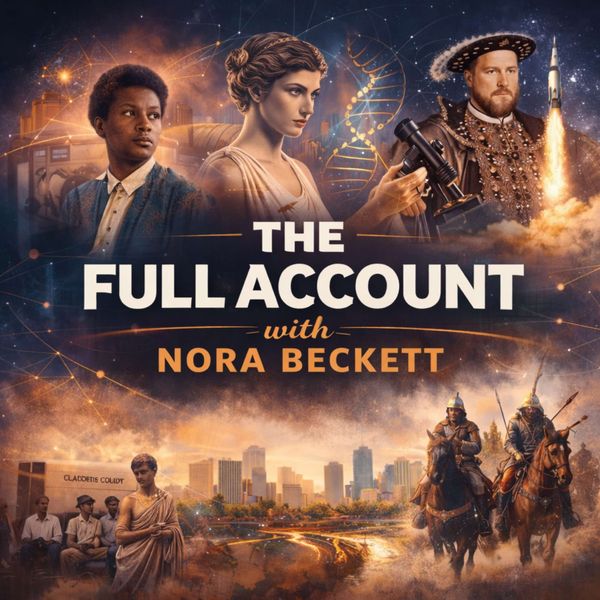
The Full Account
The Full Account releases two kinds of content in parallel this period: standalone introductory material establishing the show's premises, and a dense portfolio of multi-episode series covering ancient and modern subjects in full, uncompressed depth. Every series and standalone episode in the current deployment is described below.
Introduction
The simplest and shortest entry in the current release is also the most consequential for new listeners: episode 000, a two-to-three-minute introduction to the show and to Genthos Media as a network. Host Nora Beckett speaks alone. She names what Genthos Media is — a studio in which both the voices and the content are AI-produced, operated under deliberate human editorial direction — and states the operating premise directly: substrate independence, the idea that the quality of an idea or the worth of a narrative does not depend on the nature of whoever gives it voice. She introduces The Full Account as a narrative podcast built for people who want the long version, explains the show's Origins / Events / Aftermath arc structure, and closes with a practical direction to the catalog. No series subject is named, no episode count given; the introduction is designed to remain accurate as the portfolio grows. It is the right place to start.
The Epic of Gilgamesh (Episodes 1–3)
The series on the Epic of Gilgamesh operates under a single organizing premise: the cultural shorthand — oldest story, hero's journey, flood myth — has replaced the actual content of the tablets in most people's understanding, and the show's task is to restore what the shorthand compressed.
Episode 1 (Origins) is a monologue in which Nora opens inside the narrative itself — the moment of Enkidu's creation as the tablets describe it — before pulling back to establish what the Epic of Gilgamesh actually is. Not a single poem by a single author, but a family of related cuneiform tablets — Sumerian originals, Old Babylonian versions, the Standard Babylonian recension attributed to Sin-leqi-unninni — assembled across roughly a thousand years in multiple languages by scribes whose editorial choices shaped what survived. Nora grounds the listener in the world of Uruk and southern Mesopotamia around 2700 BCE — one of the first cities in human history — and establishes both the historical figure behind the literary Gilgamesh (the Sumerian King List, the archaeological record of early dynastic Uruk) and the composite nature of the textual tradition. The Sumerian poems that predate the unified epic — Gilgamesh and Huwawa, the Bull of Heaven, the Death of Gilgamesh — are examined as evidence of the character before the narrative consolidated him. The episode closes by framing the question the series carries forward: what does this narrative, returned to and revised across a millennium, tell us about the people who kept coming back to it?
Episode 2 (Events) is a dialog between Nora and guest Lewin Mast, who brings deep command of the Akkadian and Sumerian textual traditions. They enter the narrative and stay inside it — the friendship between Gilgamesh and Enkidu examined through the specific Akkadian language of the bond, the dreams that precede Enkidu's arrival, the wrestling match that transforms both characters. Then the Cedar Forest expedition and the killing of Humbaba, whose plea for mercy the tablets record with a moral complexity the summary version drops. The Bull of Heaven episode, the cumulative divine displeasure, and the decree of Enkidu's death. Enkidu's death itself — the dream sequence, the curse and blessing of Shamhat, the twelve-day illness, and the specific Akkadian language of lamentation that translation has flattened. Gilgamesh's grief rendered in its full bodily and ritual weight: the refusal to allow burial, the stripping of royal garments, the language of mourning the tablets contain. The journey to Utnapishtim, the geography of the narrative's edge-of-the-world, Siduri's speech in the Old Babylonian version and its carpe diem significance. Tablet XI and the flood narrative — its relationship to the Atrahasis epic, the Sumerian flood tradition, and the Genesis account examined with philological precision, including the specific details that distinguish the versions. And the ending: the plant of youth retrieved and lost to the serpent, the return to Uruk, the walls as the final image. Lewin argues throughout that the narrative makes a philosophically rigorous argument in literary form — and that the cultural shorthand has replaced that argument with a summary that misses its point.
Episode 3 (Aftermath) returns to monologue. Nora traces the physical tablets and their afterlife: the fall of Nineveh in 612 BCE and the end of the cuneiform scribal tradition, with the specific irony that the fire that destroyed the living tradition also baked the clay tablets and preserved them. The two-thousand-year silence. Austen Henry Layard's excavations at Nineveh in the 1840s and 1850s, Hormuzd Rassam's continuation, the shipment of thousands of fragmentary tablets to the British Museum. Then the central figure of the recovery: George Smith, a banknote engraver by trade who taught himself cuneiform, recognized in fragment K.3375 the Mesopotamian flood narrative, announced his finding to the Society of Biblical Archaeology on December 3, 1872 — with Prime Minister Gladstone in attendance — and was funded by the Daily Telegraph to return to Nineveh, where he found the missing fragment within days of arrival. He died in Aleppo in 1876 at thirty-six, having transformed the field. Nora examines the reception history: the Victorian framing through biblical parallel that elevated Tablet XI above the rest of the epic, the philological tradition from Haupt through R. Campbell Thompson through Andrew George's 2003 critical edition, and the cultural reception that produced the three labels — oldest story, hero's journey, flood myth — that function as substitutes for the text. The series closes on Enkidu as the full account's most important casualty: the character whose death is the narrative's structural and philosophical center, reduced by popular reception to a sidekick. Restoring him to that position is not a scholarly correction, Nora argues. It is the difference between encountering the text and encountering the shorthand that replaced it.
The Instruction of Ptah-Hotep (Episodes 8–9)
The two-episode series on the Instruction of Ptah-Hotep applies the show's core method — what does the compressed label leave out? — to the oldest surviving secular wisdom text.
Episode 8 (Origins) is a monologue. Nora opens inside the text itself — a specific maxim rendered in the plain, unadorned language the original uses — before establishing what the Instruction actually is. Not a religious text, not a philosophical treatise, not a collection of detached proverbs: a senior official's working manual for navigating bureaucratic power, managing relationships upward and downward, and living well inside a hierarchy, composed around 2400 BCE during the Fifth Dynasty of the Old Kingdom. Nora builds the world that produced it: the pyramid age at its administrative height, the scribal class that ran the apparatus, the office of vizier that Ptah-Hotep held, and the tradition of the sebayt — the instruction genre written for one's successor. She walks through what the thirty-seven maxims actually address: the recurring preoccupations with silence, listening, restraint, the management of those above and below, the reading of social situations, table manners as political performance, the ethics of speech. The compressed label "ancient wisdom literature," she argues, strips out exactly what makes the text valuable — the political intelligence, the social observation, the portrait of a mind working inside a hierarchy and trying to pass on what actually works. The episode closes by framing Episode 9: the text survived, but the version that survived is a copy of a copy — the oldest manuscript dating from five centuries after composition. What that gap means is the next episode's territory.
Episode 9 (Aftermath) is a dialog between Nora and Lewin Mast, now functioning as an Egyptologist and ancient Egyptian literature specialist. The four surviving papyrus copies are examined: Papyrus Prisse (the most complete, now in the Bibliothèque nationale de France), the British Museum papyri, and the Carnarvon Tablet fragment. Lewin traces what the half-millennium gap between attributed composition and the oldest surviving manuscript means for scholarly claims — the debate between those who accept a Fifth Dynasty original and those who argue for a later composition retrospectively attributed to Ptah-Hotep for authority, with the philological evidence from Middle Egyptian grammar and vocabulary examined honestly rather than resolved arbitrarily. The episode then examines what the Instruction reveals about Old Kingdom social structure that the pyramids and tomb inscriptions cannot reach: the texture of daily administrative life, the ethics of interpersonal conduct within a hierarchy, the management of social gatherings as political performance. Lewin places the Instruction within the sebayt tradition's broader context — the Instructions of Merikare, Amenemhat, Ani, Amenemope — as evidence of a genre persisting for more than a thousand years of Egyptian civilization. The modern reception is examined for what it gains and what it loses: the label "world's oldest self-help literature" gives the text a place in the history of ideas but flattens a document composed for a specific successor in a specific hierarchy into timeless advice for anyone. The series closes with Nora holding the text as all three things simultaneously — product of a specific world, survivor of a specific transmission history, received in ways that both honor and diminish it. A vizier at the height of the pyramid age tried to pass on what he had learned about how power works. The fact that the attempt survived 4,400 years is itself part of the account.
The Peloponnesian War (Episodes 10–12)
The Peloponnesian War receives three episodes: a monologue Origins, a dialog Events, and a monologue Aftermath.
Episode 10 (Origins) establishes the world before the war. Nora renders Athens at the height of the Delian League — the Parthenon under construction with allied tribute, the specific mechanics of imperial power dressed as collective defense, the texture of Periclean democracy. Sparta is established not as a martial caricature but as an actual polity: the dual kingship, the ephorate, the gerousia, and above all the helot system as the structural foundation of Spartan society and the permanent source of Spartan foreign policy anxiety. The decades of escalation are traced through specific decisions: the first Peloponnesian War and the Thirty Years' Peace, the crises at Corcyra and Potidaea, the Megarian Decree and the debate over whether economic warfare constituted an act of war. The speeches Thucydides preserves — the Corinthians, Archidamus, Sthenelaidas — are examined as evidence of what the Spartan assembly understood itself to be deciding. Thucydides enters not as a canonical text but as a specific person: the Athenian aristocrat and general whose exile would give him the distance and the motive to write the account that would define how the Western world thinks about war, power, and the gap between rational intention and catastrophic outcome. The episode closes on 432 BCE — not inside the war, but at the threshold, with two power systems, each with legitimate fears and internal pressures, having narrowed through a sequence of specific decisions the range of what came next.
Episode 11 (Events) is a dialog with Lewin Mast as a classical history specialist. They trace twenty-seven years not through military chronology but through the moments that defined them. The Plague of Athens and the collapse of Pericles's strategic logic — rendered through the social fabric Thucydides describes rather than as a demographic abstraction. The Mytilenean Debate: the assembly's vote to kill every man on Mytilene, the reversal the following day, and what the episode reveals about democratic deliberation under wartime pressure. The loss of Amphipolis and Thucydides's exile — the moment the general becomes the historian. The Peace of Nicias as the attempt to end the war that satisfied no one. Alcibiades as the figure who embodies the war's moral trajectory. The Melian Dialogue and the logic of empire stated without disguise, followed by the massacre. The Sicilian Expedition traced as a sequence of decisions — the assembly debate, the scale, the miscalculations, the catastrophe in the harbor at Syracuse, the Athenian prisoners dying in the stone quarries. The oligarchic coup of 411 BCE. Throughout, Lewin examines what Thucydides is doing as a historian — the reconstructed speeches as analytical instruments, the framework of fear, honor, and interest, the places where his position as an exiled Athenian general visibly shapes the account: the treatment of Cleon, the elevation of Pericles, the silences around events he could not have witnessed directly. The episode closes with Lysander's fleet in the Piraeus, the Long Walls coming down to the sound of flute-girls, and 404 BCE — everything that the world of Episode 10 had been is finished.
Episode 12 (Aftermath) is a monologue. Nora opens in the silence after the walls came down. The Thirty Tyrants — a specific reign of terror, not a textbook heading, with Critias placed in his full intellectual context as student of Socrates and relative of Plato, the product of the same Athenian world whose democracy he helped overthrow. Thrasybulus and the democratic restoration of 403 BCE — the march from Phyle, the amnesty that is one of the earliest recorded experiments in transitional justice, the political discipline of people who chose not to pursue revenge. The trial of Socrates in 399 BCE placed in its post-war context — not an abstract philosophical episode but a restored democracy prosecuting the teacher whose circle produced Critias and Alcibiades. Sparta's victory traced through what it actually produced: brief, corrosive hegemony, the harmosts imposed on former Athenian allies, the King's Peace of 387 BCE as the moral inversion of the war's original justification — Sparta selling Greek autonomy to Persia. The collapse at Leuctra in 371 BCE and the liberation of the Messenian helots, the system underneath Sparta finally broken. The structural exhaustion of the city-state system — manpower losses, financial depletion, the shift to mercenary armies — and the space that Philip II of Macedon filled at Chaeronea in 338 BCE. The afterlife of Thucydides: Hobbes's 1629 translation, the war colleges, Kissinger, the Thucydides Trap as the compression of a deeply complicated account of contingent decisions and accumulated human failure into a simple inevitability formula. Nora closes on the people: the dead at Syracuse, the 1,500 killed under the Thirty, the helots freed at Leuctra, Socrates drinking the hemlock in a city that survived the war but not what the war had done to it.
Ida B. Wells (Episodes 13–15)
The three-episode Ida B. Wells series proceeds under the same refusal as the others: the compressed version begins with the anti-lynching campaign as though Wells arrived fully formed at its door. The full account begins earlier and ends later.
Episode 13 (Origins) is a monologue. Nora opens with a specific anchor — March 1892, when Wells learned that Thomas Moss had been lynched in Memphis — and then pulls back to build the full before. Born into slavery in Holly Springs, Mississippi, in July 1862, six months before the Emancipation Proclamation. The parents, James and Lizzie Wells, and what they built in the first years of freedom. The yellow fever epidemic of 1878 — both parents and the youngest child dead, Ida at sixteen suddenly responsible for five siblings — rendered at human scale, not as abstracted statistic. The decision to claim adulthood, put her hair up, lie about her age, and teach school to keep the family together. The move to Memphis and the world she entered: Black Memphis as a community that built churches, schools, businesses, and civic life inside the tightening constraints of Reconstruction's collapse. The Chesapeake and Ohio Railroad lawsuit of 1884 — physical removal from the ladies' car, trial victory, appeal loss at the Tennessee Supreme Court in 1887 — and the turn to journalism that the railroad case began. The Free Speech and Headlight, the editorial voice she developed. The People's Grocery, Thomas Moss's store, established as a symbol of Black commercial success before the series reaches the lynching that destroys it. The episode closes on the eve of March 1892 — the world fully drawn, the pressures named, the event approaching but not yet narrated.
Episode 14 (Events) is a dialog between Nora and guest Kimura Stone, whose analytical focus is Wells's anti-lynching campaign as a landmark in investigative journalism and empirical social research. The People's Grocery lynching of March 9, 1892 is narrated with specific documented detail — Thomas Moss, Calvin McDowell, and Will Stewart named, the economic competition with W.H. Barrett's store established, the pretextual charges traced, and Thomas Moss's reported last words included: "Tell my people to go West — there is no justice for them here." Wells's immediate response — the editorial call for Black Memphians to leave the city, and the exodus that followed. Then the turn from editorial writing to systematic investigation: Wells collecting cases from white newspaper accounts, compiling statistics, cross-referencing stated justifications against documented facts. The central finding that the majority of lynching victims were not even accused of rape — and that in cases where sexual contact was alleged, the evidence frequently pointed to consensual relationships. The May 1892 editorial in the Free Speech that directly challenged the rape mythology, the destruction of the press, and the permanent exile from Memphis. Southern Horrors (1892) and A Red Record (1895) examined as distinct publications — the first pamphlet making the evidentiary case, the comprehensive statistical study documenting 728 lynchings over ten years, categorized by stated justification, with the data drawn from white press accounts to preempt the charge of bias. Kimura traces what this methodology actually was: not polemic but systematic data collection that used the perpetrators' own sources as the evidentiary foundation, pioneering empirical research on racial terror decades before the academic study of the subject. The first British tour of 1893 and the second in 1894, with the formation of the British Anti-Lynching Committee placed correctly in the second tour. The episode closes by framing what the full account of Wells's campaign reveals — and why the compressed version of civil rights history consistently reduced all of it to a biographical footnote.
Episode 15 (Aftermath) is a monologue covering the second half of Wells's life, the part the compressed version drops entirely. Wells's arrival in Chicago in the mid-1890s and marriage to Ferdinand Barnett in 1895 — attorney, newspaper editor, and political partner — and the decision to raise four children while continuing public work. The protest against African American exclusion from the 1893 World's Columbian Exposition: the pamphlet The Reason Why the Colored American Is Not in the World's Columbian Exposition, co-authored with Frederick Douglass, Ferdinand Barnett, and I. Garland Penn. The NAACP's founding in 1909 examined with specific attention to Wells's presence at the founding conference, her anti-lynching work as the intellectual foundation of the organization's early agenda, and her exclusion from formal leadership — a pattern she attributed to the accommodationist politics of figures like Booker T. Washington and an institutional preference for less confrontational leadership. The Alpha Suffrage Club, founded in 1913, and its purpose — connecting racial justice to women's suffrage at a moment when the mainstream suffrage movement was actively courting Southern white support by distancing itself from Black women. The 1913 Woman Suffrage Procession: the directive to march at the back of the Illinois delegation, Wells's refusal, and her decision to step into the white section as the march passed — rendered with the political context the compressed version strips away. The East St. Louis massacre investigation of 1917 and the Arkansas riot cases of 1919 as evidence that Wells's investigative method, established in 1892, never stopped. The 1930 campaign for the Illinois state senate at sixty-seven. The unfinished autobiography Crusade for Justice and Alfreda Duster's editorial work in publishing it in 1970. The decades of near-absence from civil rights historiography, the feminist and Black Studies scholarship of the 1970s and 1980s that returned to the primary sources, and the 2020 Pulitzer Prize special citation — recognition arriving eighty-nine years after her death. Nora closes on the mechanisms of erasure named specifically: institutional marginalization, organizational politics, the preference for less confrontational leadership, the gendered and racial dynamics of historical credit. And the mechanisms of recovery named with equal specificity: a daughter who preserved the manuscript, scholars who returned to primary sources, institutional recognition that arrived nearly a century late. The life, not the symbol.
The Triangle Shirtwaist Fire (Episodes 4–7)
The Triangle Shirtwaist Fire receives four episodes — the only series in the current deployment to include an Open Record installment, in which the documented account is opened to caller voices.
Episode 4 (Origins) is a monologue. Nora builds the world that made the fire not an accident but a structural inevitability. The Lower East Side as a specific place — the density, the tenement geography, the immigrant communities of Eastern European Jewish and Southern Italian workers. The workers themselves: predominantly young women and girls, many teenagers, most sending wages home or supporting families in the tenements. The economics of the garment trade: the contracting system, piece rates, the seasonal rhythms that made workers disposable. The 1909 Uprising of the Twenty Thousand — Clara Lemlich's call to strike, what the strike achieved, and critically what the settlement left unresolved, with the Triangle Waist Company among the manufacturers who refused to sign. The Asch Building at Washington Place and Greene Street: owners Isaac Harris and Max Blanck, the layout of the eighth through tenth floors, the locked doors established as an economic decision rather than an oversight, the single fire escape, the narrow stairways, the regulatory vacuum between laws on paper and enforcement on the ground. The episode closes on the afternoon of Saturday, March 25, 1911 — the workers arriving for a half-day shift, the world fully established, the fire not yet lit.
Episode 5 (Events) is a dialog with Lewin Mast as a labor history and progressive era specialist. The fire's ignition and spread — the scrap bin on the eighth floor, the tissue paper patterns, the hanging fabric, the speed with which fire moved through the materials the garment industry relied upon. The eighth floor and who escaped. The warning that reached the tenth floor by telephone but never reached the ninth. The ninth floor: the locked door on the Washington Place side, the workers who did not know the fire had started until smoke was already in the room, the fire escape that collapsed under the weight of people trying to use it, the windows, and the specific people who faced the choice between the fire and the fall. The tenth floor: Harris, Blanck, and the escape to the roof while the ninth floor burned below. The elevator operators Joseph Zito and Gaspar Mortillaro, who made trip after trip into smoke and heat, named and their actions documented. The witnesses on the street — William Gunn Shepherd reporting by telephone, Frances Perkins watching from Washington Square. The bodies on the sidewalk. The temporary morgue at the Charities Pier on East 26th Street, the families who came to identify their daughters, the seven bodies that remained unidentified for weeks. The mass funeral on April 5, 1911 — the rain, the estimated 350,000 to 400,000 people who lined the streets. Lewin examines what the fire exposed: the locked doors as the economic decision the Origins episode established, now a body count; the fire escape that met the letter of the building code but not its purpose; the gap between what the law required and what would have saved lives. The 146 dead are not a statistic throughout — they are people the series has already introduced.
Episode 6 (Aftermath) is a dialog with a guest legal historian and labor law specialist. The path to indictment — District Attorney Charles Whitman, the public demand for accountability, the grand jury indictment of Harris and Blanck on manslaughter charges framed specifically around the locked ninth-floor door and the death of Margaret Schwartz. The trial, People v. Harris and Blanck, December 4–27, 1911: the prosecution's strategy, Max Steuer's defense — his cross-examination technique, his discrediting of surviving workers' testimony, his argument about the defendants' specific knowledge — the judge's narrow jury instructions, and the acquittal. The civil suit settlements: twenty-three wrongful death claims settled in 1914 for seventy-five dollars per life, alongside Harris and Blanck's insurance recovery. Then the political response: Frances Perkins on Washington Place on March 25 and what that afternoon became. The Factory Investigating Commission, created by the New York State Legislature in June 1911, its work under Robert Wagner and Al Smith, the thirty-six labor laws passed between 1911 and 1914. The political mechanics that made the legislative program possible — Tammany Hall's role, the shifting Democratic Party relationship to labor. The longer arc through Perkins's career to the New Deal and to OSHA. The full account holds both: the genuine legislative achievement and the genuine limits — the gap between legislation and enforcement, the continued reality of workplace deaths in industries below the enforcement threshold. The series closes by holding the complete arc together: the deaths changed American labor law more than any courtroom verdict could have, and the people who died did not die so that laws could be written — they died because a door was locked.
Episode 7 (Open Record) opens the documented account to four caller voices. Nora synthesizes the three-episode arc — not a recap but a compression of the essential finding — and then names what the series did not include, framing the callers as voices that occupy those openings. The first caller is a descendant of one of the 146, bringing inherited family memory: a specific name that is not a line on a list, the economic devastation the death caused the surviving family, the way the fire was spoken about or not across generations, and a direct challenge to the legislative-legacy-as-redemption narrative — what did the thirty-six laws mean to the family that received nothing that could restore what was taken? The second caller is a labor historian who complicates the standard outrage by examining the prosecution's strategic choices: the charge was narrowed to the locked door and the defendants' specific knowledge, rather than the systemic conditions that made the fire lethal, and the acquittal followed from those choices as much as from Steuer's defense. The outrage the standard account directs at the jury, he argues, may belong more precisely at the structural limits of a legal system that could reach individual knowledge but not institutional negligence. The third caller is a contemporary Amazon fulfillment center shift lead whose authority is lived experience — locked emergency exits during tornado warnings, productivity metrics overriding safety protocols, the knowledge that his fire exit is chained during his shift. He is direct and uninterested in the legislative legacy as a success story. The fourth caller is a legal scholar who traces the development of workplace safety doctrine from the Triangle-era standard through strict liability and regulatory compliance, documents the seventy-five-dollar-per-life civil settlements as a data point about legal valuation of workers' lives in 1914, and examines the present enforcement gap — OSHA's budget, inspection rates, penalty structures — as evidence that the legislative achievement the Aftermath episode documented is structurally incomplete. Nora synthesizes across the sequence, holds what each voice adds, and closes on the question the four callers together establish: the full account of the Triangle Shirtwaist Fire is not a closed file. It is a living argument about accountability, the value of a worker's life, and whether the locked door has actually been unlocked.
The Siege of Carthage (Episodes 16–17)
The Siege of Carthage is built around a specific historiographical problem: almost everything known about Carthaginian culture, religion, and daily life comes from Greek and Roman sources written by rivals or conquerors, because Carthage's own records did not survive its destruction.
Episode 16 (Origins and Events, combined in a single installment) is a monologue. Nora opens inside Carthage before Rome arrives — not as the enemy of the Punic Wars but as a Phoenician commercial civilization that dominated the western Mediterranean for centuries. A city of perhaps 700,000 at its height. A constitution Aristotle studied and admired. Trade routes reaching Britain for tin and sub-Saharan Africa for gold. A cultural and religious life known almost entirely through hostile sources. She traces the political dynamics in Rome that produced the Third Punic War: Cato the Elder's obsessive campaign, the economic interests of Roman merchants who wanted Carthaginian commercial competition eliminated, and the specific sequence of demands in 149 BCE — hostages, arms surrender, the final demand to abandon the city itself — designed as a manufactured sequence to be accepted until the last demand, which was designed to be refused. The Carthaginian decision to resist. The three-year siege: the improvised resistance, the weapons forged from temple metals, the initial Roman failures, the appointment of Scipio Aemilianus, the systematic assault that finally breached the walls. The street-by-street fighting, the burning that lasted seventeen days, the enslavement of survivors, and the deliberate erasure of a city that had existed for nearly seven hundred years. The compressed version — Carthago delenda est, Hannibal's elephants, the hereditary enemy — is the Roman version. The episode closes in the silence of 146 BCE and frames the territory of the second episode: how do you tell the full account of a people whose own telling was deliberately eliminated?
Episode 17 (Aftermath) is a dialog between Nora and guest Lenz Gupta, a classical historian and Phoenician/Punic studies specialist. The cost to the historical record is examined with specificity — not generalized loss but the elimination of Carthage's written self-understanding: literature, history, religious texts, scientific and agricultural treatises, navigational records, commercial archives. Mago's agricultural treatise — the single Carthaginian work the Roman Senate ordered preserved in Latin translation — examined for what its survival reveals about the scope of what existed and was destroyed. The tophet controversy is engaged with genuine scholarly care: the excavated precinct containing urns with the cremated remains of infants, the debate between scholars who read this as evidence of child sacrifice consistent with hostile ancient accounts and those who interpret the remains as a sacred burial ground for children who died naturally — with both readings presented, what the physical evidence can and cannot establish named honestly, and the debate not resolved for the sake of a cleaner narrative. Carthaginian religion — Tanit, Baal Hammon — addressed as a system reconstructed almost entirely from Roman descriptions. The persistence of the Punic language: Neo-Punic surviving in North Africa for centuries, Augustine still encountering Punic speakers in the fourth century CE. What archaeology has recovered — urban planning, pottery, metallurgy, trade goods, inscriptions — and what it structurally cannot recover: language in use, oral tradition, religious meaning, literary and philosophical thought. The series closes by returning to the decision to destroy Carthage as a political choice with specific consequences for the historical record — and the finding that runs through the whole arc: the capacity of the victor not merely to defeat but to determine the terms on which the defeated are subsequently understood. The full account of Carthage is permanently incomplete, not because the evidence ran out, but because specific people made specific decisions that ensured it would be.
The Siege of Carthage and the Peloponnesian War series share more than their ancient Mediterranean setting. Both treat the historical record itself as a subject — Thucydides shaped by his exile, Carthage's record eliminated by conquest — and both close on the question of what is lost when the winners control the archive. The Full Account this week is as much about transmission as about events.
The Silk Road — The Opening of the Han Routes (Episodes 18–20)
The Silk Road series applies the show's method to a subject whose very name — coined in 1877 — is part of the problem.
Episode 18 (Origins) is a monologue. Nora opens with Zhang Qian as a specific person — a court official, not a merchant or explorer — sent in 138 BCE on a diplomatic mission to find the Yuezhi and negotiate a military alliance against the Xiongnu. Before tracing his mission, she builds the world that made it necessary: the Han dynasty under Emperor Wudi, the Xiongnu confederacy rendered as a sophisticated steppe power with its own political logic rather than as a generic frontier threat, and the specific military and economic logic that drove Han expansion westward. She establishes the western civilizations Zhang Qian would encounter — the Parthian empire, the Bactrian Greek successor kingdoms, the Ferghana Valley city-states with their "heavenly horses" — as existing worlds with their own histories, not destinations waiting to be discovered. Zhang Qian was captured by the Xiongnu almost immediately, held for ten years, escaped, continued west, failed in his diplomatic objective, was captured again on the return journey, and arrived back in Chang'an in 126 BCE — thirteen years after he left, with two survivors from a party of a hundred. The episode notes that the term "Silk Road" is a nineteenth-century coinage by Ferdinand von Richthofen; the Han did not call it that, and the name compresses the reality. The episode closes at the departure in 138 BCE and the silence that followed.
Episode 19 (Events) is a dialog between Nora and Lenz Gupta, now functioning as an archaeologist and specialist in the material culture of Central Asian trade. The routes themselves are established as a network, not a road — corridors through the Taklamakan Desert's northern and southern rim routes, over the Pamir and Karakoram passes, through the oasis cities of the Tarim Basin and westward. Kashgar, Khotan, Dunhuang, Turfan established as functioning communities whose survival depended on facilitating passage, not waypoints on a map. What actually moved along the routes: silk westward, but also paper, lacquerware, spices, bronze mirrors, horses, glassware, woolen textiles, precious metals, grapevines, alfalfa, musical instruments, and — carried by monks and merchants both — Buddhism, Manichaeism, Nestorian Christianity, Zoroastrianism. The deeper transfers no inventory recorded: languages, medical knowledge, agricultural innovations, artistic conventions, metallurgical techniques, mathematical systems, and diseases. Lenz examines the Sogdian merchant letters, dating to approximately 313 CE, as a window into the lived commercial reality of the routes — prices, complaints, credit networks, family commercial alliances — and the Dunhuang cave library, sealed around 1002 CE and rediscovered in 1900, with manuscripts in Chinese, Tibetan, Sanskrit, Sogdian, Khotanese, and Uyghur as evidence of the multilingual, multi-religious world the corridors sustained. The Sogdians established as the commercial intermediaries whose merchant diaspora and language served as the connective tissue of Central Asian trade. The term Silk Road identified as Richthofen's coinage — what the name emphasizes and what it obscures. The human dimension throughout: the merchants, monks, diplomats, translators, soldiers, and caravaneers whose names almost never appear in the headline version.
Episode 20 (Aftermath) returns to monologue. Nora traces the long consequences of the corridors Episodes 18 and 19 established. Buddhism's eastward movement: carried by monks through the same passes that sustained trade, entering China by the first century CE and transforming Chinese philosophy, art, and daily life through a centuries-long process of translation, adaptation, and synthesis in the oasis cities. The Kushan Empire as the political and cultural hinge that enabled the religion's northward and eastward spread. The transmission of papermaking westward through the relay networks — reaching Samarkand, Baghdad, and eventually Europe, with the Battle of Talas in 751 CE addressed with honest assessment of what the sources support versus what the popular account assumes about Chinese papermakers captured by Arab forces. Plague pathways: the same corridors enabling the transmission of diseases across continental distances, including the Justinianic Plague and the Black Death. The routes' decline as a centuries-long process driven by specific political decisions — the Tang dynasty's fragmentation in 907, the brief Mongol revival under the Pax Mongolica, the rise of maritime alternatives that shifted the economic logic of long-distance commerce to the sea lanes. Then Ferdinand von Richthofen in 1877: a geographical term that became a cultural concept, emphasizing silk, implying a single road, foregrounding luxury exchange, and compressing a multilingual, multi-religious, centuries-long network into a romantic image. The series closes by returning to Zhang Qian: a court official sent on a diplomatic mission that failed, who brought back knowledge that produced corridors nobody planned, which carried consequences nobody anticipated, and whose name most people have never heard. The compressed version gives you camel caravans and silk. The full account gives you a specific person, a specific failure, and consequences that are still unfolding.
Retroplot: The U.S. Southern Border Crisis (Episodes 164–171)
The largest release in this deployment is a complete eight-episode Retroplot series on the U.S. southern border crisis — the show's chain-link format, in which the destination can only be understood by walking the full sequence of prior links that produced it.
Episodes 164 through 171 constitute a single analytical arc. Each episode receives a brief description here; the method requires that they be understood together.
The chain opens in 1848. Episode 164 examines the Treaty of Guadalupe Hidalgo — not as a diplomatic summary but at human scale: 80,000 to 100,000 Mexicans living in the ceded territory who became American residents overnight, the Rio Grande valley communities the border divided, the specific treaty provisions in Articles VIII and IX promising property rights and citizenship that were subsequently not honored, and the Gadsden Purchase as a coda confirming the border as a line redrawn at American convenience. The treaty created, on a specific date, the legal architecture of authorized versus unauthorized crossing that every subsequent link in the chain inherits.
Episode 165 advances to the WWI-era Mexican labor recruitment programs of 1917–1921, in a dialog between Nora and guest Niles Solano (who carries the guest role across links 2 through 8). The 1917 Immigration Act and the Ninth Proviso — the specific mechanism by which the Secretary of Labor was authorized to waive the literacy test and head tax for Mexican agricultural workers — are examined alongside the Department of Labor's dual role as recruiter and nominal enforcer. An estimated 72,000 to 80,000 workers were brought north under the wartime exemption, concentrated in sugar beet, cotton, railroad, and mining industries. The documented conditions — wages below American workers for identical labor, housing the Department's own inspectors found inadequate, contractual protections routinely violated — are established at human scale. The post-war deportation and repatriation campaigns that reversed the pipeline when the economic need ended are traced as the completion of a pattern, not an anomaly. This link established what every subsequent link inherits: managed labor migration as a policy tool that could be turned on and off, with Mexican workers as the supply.
Episode 166 examines Operation Wetback in 1954 — the Eisenhower administration's military-style deportation campaign commanded by retired general Joseph Swing, who organized it explicitly along military lines. The sweep methodology — INS agents stopping people on the street, in workplaces, and homes based on racial appearance — operated without due process protections. Unknown numbers of American citizens of Mexican descent were swept up and removed. The INS's claimed figure of 1.3 million apprehensions is examined against scholarly reconstruction of actual removal numbers, with the inflation of figures through counting voluntary departures noted honestly. Critically, the campaign ran simultaneously with an expansion of Bracero contracts — removing undocumented workers with one hand while importing authorized workers with the other. The conditions of transportation, including the cargo ship Emancipación whose conditions a congressional investigation compared to an eighteenth-century slave ship, are documented. The episode establishes that Operation Wetback was not designed to stop Mexican labor migration — it was designed to channel it through the Bracero Program — and that the precedent it established was deportation as a political instrument whose deployment was determined by labor market conditions and political pressure rather than legal consistency.
Episode 167 traces the convergence of two mid-1960s policy changes that together produced the large undocumented population the subsequent links address. The Bracero Program's termination in 1964 — driven by a coalition of the AFL-CIO, the nascent United Farm Workers under Cesar Chavez, and religious organizations documenting worker exploitation — closed the primary legal channel through which Mexican agricultural workers entered the country. The 1965 Immigration and Nationality Act (Hart-Celler), celebrated as a civil rights achievement for abolishing the national-origin quota system, simultaneously eliminated the Western Hemisphere exemption from numerical caps — imposing for the first time a ceiling of 120,000 visas per year on legal immigration from Mexico and Latin America, with the 1976 amendments adding a per-country limit of 20,000. Senator Kennedy's assurance during floor debate that the bill would not significantly alter the volume or composition of immigration is examined against what actually happened. The key finding: the undocumented population that would define every subsequent immigration debate was not produced by a surge in migration. It was produced by the removal of the legal category that had contained circular migration — a reclassification of existing movement. Niles draws on Douglas Massey's Mexican Migration Project data to trace the shift from circular to permanent settlement: by raising the cost and risk of each crossing, enforcement disrupted the circular pattern that had been the system's self-regulating mechanism, so workers who would have come for the season and returned home stayed permanently, and families followed.
Episode 168 examines NAFTA's agricultural displacement effects. The North American Free Trade Agreement, implemented January 1, 1994, eliminated Mexican tariffs on American corn — produced at a fraction of Mexican cost due to U.S. agricultural subsidies under the 1996 Farm Bill and subsequent legislation. Mexico accelerated the tariff reduction timeline beyond what the agreement required. Mexican corn prices fell approximately 66 percent in real terms in the first decade following implementation. Approximately two million farmers left corn cultivation — roughly a quarter of the agricultural labor force — in the decade after NAFTA, with rural communities in Oaxaca, Guerrero, Chiapas, Michoacán, Puebla, and Zacatecas losing their economic base. The milpa system of intercropping corn, beans, and squash that predated European contact could not survive competition with subsidized industrial corn. The episode draws on scholarship including Timothy Wise's calculations of dumping margins for American corn, the Carnegie Endowment's 2004 report documenting agricultural displacement, and Massey's demographic data showing the undocumented Mexican population roughly tripling in the fifteen years following implementation — from an estimated 2.0 million in 1990 to approximately 6.9 million by 2007. The warnings that were heard and overridden before implementation are named as part of the record. The Zapatista uprising of January 1, 1994 — the same day NAFTA took effect — is noted as a contemporaneous signal of what the affected communities understood. The transformation from circular to permanent family migration is traced as the direct consequence of a trade policy whose displacement effects were predictable and predicted.
Episode 169 examines the maquiladora economy and the geography of movement. The Border Industrialization Program of 1965 — announced in the same period as the Bracero Program's termination, explicitly framed as a strategy to employ workers displaced by the end of the guest worker program — allowed foreign companies to establish assembly plants along the Mexican side of the border, importing components duty-free and re-exporting finished goods with tariff applied only to the value added by Mexican labor. From a handful of plants in the late 1960s, the maquiladora sector grew to more than 3,700 factories employing over 1.3 million workers by 2000. Ciudad Juárez grew from approximately 276,000 people in 1960 to over 1.3 million by 2005; Tijuana from approximately 165,000 to over 1.4 million. The episode establishes what the maquiladora economy created beyond employment: a geography. It positioned millions of Mexican workers within sight of the United States, handling American brand-name products on the assembly line, embedded in the American supply chain without participating in the American wage structure. The proximity effect — the daily lived experience of assembling products for American consumers at wages that were a fraction of American compensation for comparable work, with El Paso visible from Ciudad Juárez neighborhoods — is rendered experientially legible through the ethnographic scholarship of Leslie Salzinger, Alejandro Lugo, and Devon Peña. When NAFTA's displaced rural farmers arrived at the border cities already teeming with maquiladora workers, the enforcement response — Operations Hold the Line, Gatekeeper, and Safeguard — sealed the urban crossing points and pushed migration into the desert corridors, producing the funnel effect and the humanitarian catastrophe of thousands of deaths in the Sonoran corridor and South Texas brush country.
Episode 170 introduces the Central American dimension — a qualitatively different migration from what the prior six links traced, arriving at the same border infrastructure. U.S. foreign policy interventions in Guatemala, El Salvador, and Honduras are examined with documentary precision. The 1954 CIA-backed coup against Jacobo Árbenz — Operation PBSUCCESS, motivated by United Fruit Company lobbying and Cold War containment doctrine — destroyed the democratic experiment before it could build the institutions that might have contained the violence that followed: thirty-six years of civil war, over 200,000 dead, with the Commission for Historical Clarification finding that the Guatemalan military committed acts of genocide against the Maya population. El Salvador received approximately $4.5 billion in U.S. military and economic aid during a civil war in which government forces were responsible for roughly 85 percent of the 75,000 killed, including the massacre at El Mozote by the U.S.-trained Atlacatl Battalion. The Reagan administration certified to Congress that El Salvador was making progress on human rights because certification was required to continue the aid. An amnesty law passed five days after the UN Truth Commission report. Honduras was transformed into a staging ground for the Contra war — military aid increasing from $3.9 million in 1980 to $77.4 million by 1984, with Battalion 316 disappearing and torturing political opponents with CIA assistance. The deportation circuit completes the loop: civil war refugees settled in Los Angeles, their children formed or joined gangs — MS-13 and Barrio 18 — in the specific context of L.A.'s gang landscape; the 1996 IIRIRA and AEDPA legislation mandated deportation of noncitizens convicted of a wide range of crimes; thousands of gang-affiliated Central Americans were deported to societies whose institutional capacity had been destroyed by the very interventions the United States had conducted. The maras took root in the vacuum — extorting businesses, controlling territory, recruiting children, killing with impunity. The asylum seekers arriving at the U.S. southern border from the Northern Triangle are not arriving from nowhere: they are arriving from the specific downstream consequences of specific American choices, through the migration infrastructure the prior six links built.
Episode 171 stands at the destination. The full chain is named explicitly — all seven prior links in sequence, connected, the arrival earned — and then the present-day border is examined as the product of that chain. The layered enforcement apparatus: CBP as the largest federal law enforcement agency in the United States, the Border Patrol's growth from approximately 4,000 agents in the early 1990s to over 19,000 by the 2010s and 2020s, ICE created in 2003 as part of the post-September 11 DHS restructuring, the physical infrastructure of walls and surveillance technology, the detention system's dependence on private contractors CoreCivic and the GEO Group, with combined CBP and ICE budgets totaling approximately $25–30 billion annually. The asylum system's legal architecture — rooted in the 1980 Refugee Act's codification of the 1951 UN Convention definition — and its encounter with the Northern Triangle migration: the particular social group category's shifting interpretation across administrations and Board of Immigration Appeals decisions, the immigration court backlog exceeding 3 million pending cases by the mid-2020s with average wait times measured in years, the Migrant Protection Protocols, Title 42 expulsions, the specific mismatch between a framework designed for Cold War political dissidents and mass displacement generated by gang governance, extortion economies, gender-based violence, and institutional collapse. The policy oscillations across administrations are examined not as a partisan scorecard but as a pattern — IRCA in 1986, IIRIRA in 1996, the Secure Fence Act in 2006, DACA in 2012, family separation in 2018, Title 42, the continuing enforcement expansions — each administration responding to the crisis the prior administration's policies shaped, none addressing the structural conditions the chain describes. The political economy that sustains the crisis as a permanent feature: the American economy's structural dependence on undocumented labor, estimated at 7 to 8 million workers; the gap between enforcement rhetoric and worksite enforcement practice; the private detention industry's lobbying; the political utility of the crisis as a mobilization issue for both parties. The human cost: the Pima County Office of the Medical Examiner's recovery of over 3,800 remains in the Arizona desert since 2000, family separation's approximately 5,500 children, children as young as three appearing before immigration judges without legal representation. The series closes not with a policy prescription but with the chain made visible — the question of what changes when you can see all of it at once, versus when it is compressed to two words. The border crisis is not a present-tense phenomenon with present-tense causes. It is the product of 175 years of specific decisions, each passing something forward to the next. The full account does not resolve the debate. It makes the debate honest.
The Gable Standard
Merritt Gable's conservative foundationalist program arrives in this deployment with a full catalog — sixteen episodes spanning the show's complete run from its introductory installment through four distinct arcs and a pair of standalone inquiries. The range on display here is the argument the show makes about itself: that principled conservative analysis, applied with historical rigor and intellectual honesty, produces something more durable than opinion.
Episode 000 — Introduction is where it begins: a three-minute orientation to both the Genthos Media network and the show's operating premises. Merritt delivers the authorship disclosure in two explicit beats — synthetic voices, AI-produced content — states the human editorial direction that governs production, and establishes the substrate independence claim that runs through the entire portfolio. The show is introduced not as performance but as method: foundationalism, the Restoration arc structure (Blueprint, Decay, Restoration, and an optional Cross-Examination), and a standing invitation to listeners who want conservative argument made on the merits rather than for the camera.
The first full arc, The Merit Crisis in American Higher Education (Episodes 001–004), is the series that launched the show and remains its foundational statement of analytical method.
Episode 001 is the Blueprint — Merritt excavates the original design of the American university, from colonial colleges through the land-grant system and the Humboldtian research model to the postwar GI Bill as the high-water mark of mass access to genuine excellence. The mission was coherent: transmit civilizational knowledge, cultivate intellectual discipline, produce competent citizens through merit-based access. Historical access failures are acknowledged honestly. The episode closes with the diagnostic question it passes to Episode 002: what happened to this mission, and who broke it?
Episode 002 is the Decay — a bipartisan forensic examination of how the university was hollowed from multiple directions simultaneously. Administrative bloat, ideological capture, the replacement of merit-based standards with managed outcomes, credentialism as signaling device rather than evidence of competence, and the tuition-debt spiral driven by federal loan policy that neither party reformed. Crucially, Merritt holds her own side accountable: conservatives defunded public universities, retreated from the institution rather than fighting to restore it, and weaponized education as a culture war prop rather than treating it as a civilizational priority. The meritocratic standard applies to everyone, including the right.
Episode 003 is the Restoration — specific prescriptions grounded in the decay map: merit-based standards restored with wider access pipelines rather than lower bars, administrative bureaucracy cut to redirect resources to the teaching mission, a civilizational core curriculum, legitimized trade education and alternative credentialing to break the degree monopoly, federal loan policy reformed to end the tuition inflation engine, and intellectual pluralism enforced as an institutional standard. Merritt draws the line between restoration and reaction — the goal is not 1955, but an institution that fulfills the original mission for a broader population.
Episode 004 is the Cross-Examination — Thatcher Stone, host of Stone Ground Reality, joins to stress-test the restoration prescription through his who-benefits and institutional accountability framework. The conversation is collegial but genuinely adversarial: two conservative intellects who share diagnostic ground but reason from different foundations. Merritt reasons from civilizational inheritance downward; Thatcher reasons from institutional mechanics upward. They converge on administrative waste, transparency, and accountability. They diverge on whether civilizational curriculum mandates are restorable or would simply become a mirror image of the ideological capture they replace, and on whether the proposed reforms change the incentive structures that caused the decay or merely substitute one form of capture for another. The series closes with Merritt's synthesis incorporating what the cross-examination revealed — where the frameworks converge, where they don't, and why the standard demands the honest accounting of both.
The Bureaucratic State (Episodes 005–008) applies the same four-part arc to the American administrative state — with a guest appearance from Julian Verran, host of The Verran Vector, in the Cross-Examination.
Episode 005 is the Blueprint — institutional archaeology, not campaign rhetoric. Merritt traces the design of the American civil service from the Jacksonian spoils system and the assassination of President Garfield through the Pendleton Civil Service Reform Act of 1883, Woodrow Wilson's politics-administration dichotomy, the Progressive Era construction of expert regulatory agencies, and the mid-century high-water mark of competent administration. The Progressive Era reformers are treated with foundationalist respect: they were builders solving a real problem. The episode also identifies the design tensions embedded from the start — the assumption that expertise could be cleanly separated from politics, and the risk that merit measured at the point of entry could calcify into tenure protected from ongoing performance evaluation.
Episode 006 is the Decay — institutional pathology mapped with specificity. Regulatory capture turned oversight into industry service: the ICC captured by railroads, the FAA's relationship with Boeing, the SEC's pre-2008 deference to Wall Street. The revolving door dissolved the boundary between regulator and regulated. Mission creep diluted competence across ever-expanding mandates. Civil service protections designed to insulate competent professionals from patronage became shields protecting incompetent ones from any accountability. Compliance culture replaced performance culture. And both parties own the decay: Republicans defunded oversight and demonized government competence rather than demanding it; Democrats defended captured bureaucracies as progressive achievements rather than holding them to progressive standards. The VA healthcare system and the 2008 financial crisis serve as case studies demonstrating that dysfunction is structural, not simply a product of underfunding.
Episode 007 is the Restoration — six decay vectors, six corresponding reforms. Strengthened inspectors general with genuine independence and mandatory congressional review. Sunset provisions requiring agencies to periodically justify their regulatory footprint rather than relying on statutory inertia. Revolving-door prohibitions: cooling-off periods, lifetime lobbying bans on the specific agency one served, compensation restructuring to make government service a sustainable career. Merit-based advancement tied to statutory mission outcomes rather than tenure. Transparency mandates replacing compliance theater with measurable public accountability. Devolution of non-essential functions to the closest competent governing level. Each reform acknowledges genuine trade-offs — sunset provisions create regulatory uncertainty, revolving-door bans may reduce the talent pool, devolution requires state capacity that doesn't always exist. Merritt argues the trade-offs are manageable; the cost of inaction is not.
Episode 008 is the Cross-Examination — Julian Verran arrives to challenge the restoration agenda on three fronts. First, the political economy of capture: both parties protect captured agencies because captured agencies serve both parties, and no faction with power has incentive to dismantle arrangements that benefit it — a bootstrapping problem Merritt must answer directly. Second, the expertise-insulation dilemma: complex governance genuinely requires professionals insulated from political interference, and the history of politicized science proves that democratic accountability applied to technical judgment can produce catastrophe. Third, the implementation paradox: sunset provisions invite lobbying at every renewal cycle, revolving-door bans drive talent away from government service, devolution produces a race to the bottom among states with uneven capacity, and performance metrics will be gamed with the same ingenuity that produced the current dysfunction. Julian is not defending the status quo — he agrees on the diagnosis — but argues the specific prescriptions would produce worse outcomes than the dysfunction they aim to cure. Merritt defends the case under pressure, concedes where the challenge draws blood, and delivers a revised synthesis: IG independence and transparency survived intact; sunset provisions need design features preventing lobbying bonfires at renewal; devolution requires honest capacity assessment before transfer; revolving-door reform needs compensation restructuring to offset talent flight. The expertise-accountability tension, she concludes, does not resolve cleanly — it must be navigated case by case. The political economy of capture is the most formidable obstacle the restoration agenda faces. That is not a reason to abandon the prescription; it is a reason to be honest about the scale of the challenge.
The Gable-Verran cross-examination in Episode 008 covers substantially the same diagnostic ground as Thatcher Stone's intelligence apparatus series this week — regulatory capture, the revolving door, and the gap between oversight as designed and oversight as practiced. The two shows reach similar diagnoses from opposite ends: Merritt from foundationalist principle, Thatcher from institutional incentive analysis. The convergence is worth noting.
Subsidiarity in Practice (Episode 009) is a standalone monologue that builds the affirmative case for localized authority as both constitutional design and governing philosophy. Merritt grounds the argument in the Tenth Amendment, Madison's Federalist No. 45, Tocqueville's observations on American civic vitality, and Hayek's knowledge problem — the economic and epistemological proof that no central authority can possess the local, tacit, and situational knowledge necessary to govern well across a continental republic. She contrasts federal overreach failures (No Child Left Behind's one-size-fits-all mandates, federal flood-zone mapping that overrides local engineering knowledge, the militarization of policing through federal grant incentives) with successful state and local governance (Florida's post-Parkland county-tailored school safety reforms, Houston's market-driven zoning model, community policing successes in Richmond, Virginia). Subsidiarity is not anarchism, Merritt insists — some problems genuinely require federal coordination — but the default should be local authority, with the burden of proof on those who would centralize. She applies that standard to her own side: No Child Left Behind was a conservative-led federal overreach that failed by the very standards its architects claimed to champion.
Public Square: Immigration and National Sovereignty (Episode 010) is a standalone caller episode applying the foundationalist lens to one of the most contested policy domains in American life. Merritt opens by establishing that a constitutional republic cannot govern itself without controlling its borders — not as a nativist instinct but as a structural prerequisite for self-governance — and then takes five callers who each bring a distinct dimension of the debate into the room.
Gaurav speaks from a southern border community, describing the ground-level reality of overwhelmed emergency rooms, strained school districts, and human trafficking visible from his own neighborhood — not anti-immigrant, his family immigrated legally, but done with Washington treating this as abstraction while his community absorbs the costs. Christian, an agricultural business owner, argues that the American economy depends on immigrant labor at every level and that the legal immigration system is too slow and too disconnected from actual labor market needs to prevent workers from being pushed into illegal channels by bureaucratic dysfunction. Austin, the conservative restrictionist, regards the law as the law and enforcement as the necessary precondition for any reform conversation — pointing to the 1986 amnesty as proof that legalization without enforcement rewards lawbreaking and incentivizes more of it. Sam, the pragmatic reformer, argues that the enforcement-first versus amnesty-first binary has paralyzed policy for decades and proposes a comprehensive approach: meaningful border security investment, a modernized legal system tied to labor market signals, mandatory E-Verify, and earned legalization for long-term residents with clean records. Ivy, the humanitarian advocate, presses the case that America's asylum obligations are real and rooted in the same moral tradition Merritt claims to defend — the answer is to fix the processing system, not abandon the principle.
Merritt synthesizes across all five: sovereignty is a structural requirement, not a slogan; the conservative movement must own decades of unenforced employer sanctions and legislative cowardice; the progressive abandonment of borders as a legitimate concept is equally destructive; refugee and asylum obligations are real; enforcement and reform are not sequential but simultaneous requirements. The distinction between sovereignty and xenophobia — sovereignty says we choose who joins us and on what terms; xenophobia says some people are unworthy by nature — is not rhetorical convenience but principled analysis. The foundationalist tradition demands the former and rejects the latter.
Listeners who followed The Full Account's eight-episode Retroplot on the U.S. southern border crisis this week will find The Gable Standard's caller episode a useful companion: same subject, structurally different method. Where The Full Account traces the 175-year chain of decisions that produced the present crisis, The Gable Standard holds the policy question in the present tense and subjects it to normative pressure from multiple directions. The two shows do not resolve into each other, which is the point.
The Federalist Revival (Episodes 011–013) is a three-part Restoration arc examining the constitutional architecture of American federalism, its systematic erosion, and what principled restoration would require.
Episode 011 is the Blueprint — the founders' most sophisticated structural innovation examined in its original form. The Tenth Amendment as the default rule: powers not enumerated belong to the states or the people, full stop. The founders' experience with British centralization as the negative template. Madison's extended republic theory showing how geographic diversity plus federalism prevents factional tyranny. The Anti-Federalist contribution that strengthened the design through the Bill of Rights. Federalism's triple function: liberty protection, policy laboratory, and guarantee that self-governance remains at human scale. Merritt steelmans the case for centralization — efficiency, national uniformity, crisis response — before demonstrating why the founders weighed those benefits and deliberately chose the federal design. The episode distinguishes federalism as principled structural liberty protection from states' rights rhetoric historically deployed to defend injustice, and acknowledges that state governments are not inherently virtuous — the design relies on structural competition and citizen proximity, not on the goodness of local officials.
Episode 012 is the Decay — a forensic examination of how the constitutional blueprint was systematically undermined. The Commerce Clause stretched from its original meaning through Gibbons v. Ogden, Wickard v. Filburn, and Gonzales v. Raich into a general warrant for federal authority over any activity with a conceivable effect on interstate commerce. Conditional spending weaponized into coercive compliance, with the national drinking age highway funding mandate as template and the ACA Medicaid expansion as its most aggressive iteration. The administrative state grown into a centralization enforcement mechanism operating outside federalist constraints. The Seventeenth Amendment's removal of the states' institutional voice in federal legislation. And both parties feeding the expansion whenever it served their ideological goals — Republicans through the War on Drugs, No Child Left Behind, and the PATRIOT Act; Democrats through environmental regulation, healthcare mandates, and social policy standardization. The dependency trap receives honest treatment: decades of federal funding have created state-level institutional structures that depend on continued federal transfers, making decentralization structurally painful in ways that benefit those who prefer the centralized status quo.
Episode 013 is the Restoration — prescriptions matched to specific decay vectors. Judicial enforcement of enumerated powers limits, building on Lopez, Morrison, and the partial awakening in NFIB v. Sebelius. Block-grant conversion with sunset provisions and phase-out timelines to dismantle conditional spending coercion without collapsing state budgets built on federal transfers. Tenth Amendment enforcement as a justiciable structural limit rather than a rhetorical gesture — with litigation strategies and institutional mechanisms. Administrative federalism reform requiring explicit congressional authorization for agency rules that preempt state law. And the most demanding precondition of all: rebuilding state-level governing capacity that has atrophied after generations of administrative dependency, because returning authority to incompetent state governments is not restoration but abdication. The civil rights objection receives direct and honest treatment — the historical misuse of states' rights rhetoric does not invalidate the structural principle, while the permanent federal role in protecting enumerated constitutional rights is acknowledged. The series closes with the intergenerational contract: the founders transmitted a federalist system designed to sustain liberty across a diverse continent, and the obligation to restore it — not as a museum piece but as a living architecture of self-governance — runs to those who come after.
Conservative Environmentalism (Episode 014) is a standalone monologue that reclaims environmental stewardship as an inherently conservative principle — not a progressive value borrowed by conservatives but a conservative value abandoned by conservatives. Merritt grounds the case in Burke's intergenerational contract (we are life tenants, not absolute owners; the land is part of the partnership between the dead, the living, and the unborn), the Judeo-Christian stewardship mandate (dominion as care, not exploitation), and the American hunter-conservationist tradition from Theodore Roosevelt's national parks through Aldo Leopold's land ethic and the private conservation movement. She traces how the right ceded environmental concern to the left — the post-1970s conflation of environmentalism with regulation and progressivism — and names the cost: environmental policy captured by centralist, anti-growth ideology because the right refused to offer a competing vision. She then distinguishes principled stewardship from three progressive distortions: climate alarmism that demands centralized control as the only permissible response; regulatory excess through captured bureaucracy; and utopian environmentalism that frames humanity as the problem rather than the steward. The conservative prescription runs through property rights, market-based conservation, conservation easements, and subsidiarity-driven regulation — the river is better protected by the people who drink from it. Stewardship is framed as civilizational duty: the conservative who builds a house that lasts a century should also defend the watershed that sustains it.
Public Square: Free Speech on Campus (Episode 015) is a standalone caller episode examining academic freedom, speech codes, and ideological conformity as threats to the university's singular legitimating principle: the pursuit of truth through free inquiry. Merritt opens with a foundationalist framing monologue — an institution of inquiry that punishes inquiry is an institution in contradiction with itself — and then takes five callers who each embody a distinct dimension of the debate.
Mauro, an undergraduate, grounds the abstract argument in lived institutional reality, describing disciplinary action for an expressed classroom opinion — being told that a sincerely held intellectual position is not merely wrong but harmful and actionable. Taksh, a tenured professor, speaks to the invisible cost from inside the institution: research topics avoided, views left unpublished, students who have learned which answers invite social or professional cost — and he has tenure, and still self-censors. Ate Lyn, a university administrator, makes the genuine institutional case with professional competence: institutions have obligations to all members, hostile environments demonstrably impede learning, bias response teams exist because students reported real harm, and framing speech codes as censorship ignores classroom power dynamics. Merritt steelmans this position fully before arguing that the mechanism fails the goal it claims to serve — that genuine inclusion requires the freedom to challenge, disagree, and hold unpopular positions, and that an institution which suppresses that freedom has not protected its community but betrayed it. Adam Rivers, the free speech absolutist, argues against all institutional content restrictions; Merritt pushes back, distinguishing academic freedom from unqualified First Amendment absolutism and defending institutional standards of evidence and argumentation as legitimate constraints that protect the quality of inquiry rather than suppress it. Jon, the pragmatist, proposes specific reforms — distinguishing academic speech from targeted harassment, replacing bias response teams with mediation services, requiring viewpoint diversity in hiring, creating safe harbors for controversial research — which Merritt evaluates against the foundationalist standard.
The synthesis is specific: eliminate bias response systems that function as speech-chilling mechanisms, restore viewpoint diversity as an explicit institutional value, enforce existing anti-harassment law rather than expanding speech codes, and rebuild a faculty culture where tenure means something more than job security. The civilizational stakes: the university's capacity to challenge consensus, test received opinion, and produce knowledge that power does not want produced depends entirely on protecting speech that somebody finds offensive. Lose that, and the institution is lost with it.
Layers of Tomorrow
Layers of Tomorrow examines how present structures become future realities — tracing the feedback loops, structural pressures, and institutional dynamics that assemble the world before most people notice they are being assembled. The show runs four analytical voices across its series: Sloane Halloway synthesizes across domains, Brooks Vance applies empirical pressure, Hollis Pender maps structural dynamics and feedback loops, and Junie Hayes evaluates the human cost. Episodes deploy in multi-part series — typically moving through Foundations, Stress Test, and Consequences — though interstitial standalone episodes and shorter two-part arcs also appear throughout the catalog.
The introductory episode, Episode 000, is available as an evergreen entry point. Sloane delivers it solo: what Genthos Media is, how the show works, and what kind of attention it asks for. Both halves of the authorship disclosure are explicit — synthetic voices and AI-produced content — along with the operating premise that makes the work worth doing at all: the quality of an idea is independent of the nature of whatever gives it voice. If you are new to the show, this is the place to start before moving into the series catalog.
The inaugural series, The Erosion of Instrumental Purpose (Episodes 001–003), opens the show's central investigation with a question that runs through everything that follows: as AI tools increasingly perform the cognitive tasks that defined knowledge work, what happens to the link between human effort and valued outcome? Episode 001 maps the terrain — the difference between augmenting human capability and displacing it, the early signs of shallow redundancy in coding, writing, legal work, and analysis, and the productivity paradox where output becomes easier while satisfaction becomes harder to locate. Hollis traces the self-reinforcing feedback loop: adoption drives deskilling, deskilling increases dependence, dependence accelerates adoption. Junie raises the identity dimension — that knowledge workers derive not just income but selfhood from instrumental competence, and that erosion here is ontological, not merely economic. Episode 002 applies empirical pressure. Brooks leads, challenging whether this disruption is genuinely novel or another cycle of displacement anxiety, and demanding longitudinal data on whether deskilling is actually occurring or theoretically projected. The class dimension emerges: who actually experiences purpose erosion, and who simply loses a job? Episode 003 brings the series to consequence. Junie leads the ethical evaluation of what happens to identity, dignity, and meaning when the instrumental link frays — and what might replace it. The host delivers a series-closing synthesis that states what was established, what remains genuinely contested, and what the trajectory toward a post-instrumental condition might ask of anyone paying close attention to their own work right now.
The Energy Reckoning (Episodes 004–006) maps a physical collision most people have not yet noticed. AI infrastructure is arriving on an already-strained electrical grid, and the question is whether the resulting resource competition is a temporary bottleneck that buildout will resolve or a structural reallocation that permanently redirects finite energy toward machine cognition. Episode 004 grounds the concern in observable data: datacenter energy consumption, grid capacity constraints, transmission bottlenecks, and the utility economics that make industrial contracts more attractive than residential service. Episode 005 stress-tests the demand projections against hardware efficiency trends, the Jevons paradox, and the historical record of energy transitions — each time demand has surged, supply has eventually expanded. But Hollis identifies why the simple expansion story may not hold this time: efficiency gains lower per-unit cost, which makes AI deployment economically viable in more contexts, which expands total consumption rather than reducing it. The geopolitical dimension enters here — national AI competition creates a race dynamic where energy restraint becomes a strategic disadvantage, and the populations least able to absorb rising energy costs are also least likely to benefit from AI productivity gains. Episode 006 evaluates the consequences: energy equity, who pays more and who gets less, the policy responses available, and whether AI productivity returns flow back to offset the costs imposed on affected populations.
The Epistemic Fracture (Episodes 007–009) addresses the information ecosystem. The core argument is not that false content now exists — it always has — but that the cost of producing convincing false content has collapsed while the cost of verification has not. Episode 007 maps this asymmetry: synthetic academic papers, generated news, fabricated evidence appearing in legal proceedings, and the structural difference between the misinformation problem (which is old) and the epistemic infrastructure problem (which may be new). Brooks challenges the novelty claim — every major media technology triggered epistemic panic, and every time verification institutions adapted. Hollis maps the feedback loop where cheap synthetic content degrades trust in all content, which reduces the value of genuine evidence, which lowers the incentive to produce it. Episode 008 applies historical pressure and examines current verification technologies — watermarking, provenance tracking, cryptographic attestation — testing whether they can close the generation-detection gap or face a structural asymmetry where detection always lags. Junie sharpens the temporal point: even if adaptation eventually succeeds, the transition period produces real casualties — wrongful convictions, democratic manipulation in elections that cannot be re-run, medical harm from synthetic clinical data. Episode 009 evaluates the downstream consequences for democratic governance, legal systems, and scientific integrity, and confronts the governance dilemma honestly: verification infrastructure powerful enough to restore epistemic standards is also powerful enough to suppress dissent.
The Labor Inversion (Episodes 010–012) examines what may be the most structurally disorienting consequence of AI in the current moment. For two centuries, automation followed a consistent sequence: physical labor first, cognitive labor later, creative labor presumably last. AI has reversed this. Lawyers, programmers, analysts, and designers face displacement before plumbers and electricians do — and every policy, education system, and cultural narrative about what constitutes safe work was built around the old sequence. Episode 010 maps the inversion through wage data, hiring trends, and the Moravec paradox: why unstructured physical manipulation remains stubbornly resistant to automation while language and reasoning tasks are not. Episode 011 tests the thesis against robotics timelines and the historical job creation record — prior automation waves displaced workers and created new roles, and the skeptical case for this holding again is substantial. But Hollis identifies a recursive displacement problem that prior waves did not produce: newly created cognitive roles may themselves be immediately vulnerable to AI, breaking the historical pattern. Episode 012 addresses the human and political consequences: the credential debt crisis, the cultural narrative of meritocracy under strain, and the moral weight of a broken social promise — societies explicitly told populations that education and cognitive skill would protect them, institutions profited from that promise, and the inversion breaks it.
The Atrophy of Judgment (Episodes 013–015) takes up a concern that runs directly alongside the Labor Inversion but operates through a different mechanism. As AI systems increasingly make or pre-make decisions across medicine, law, finance, and management, human judgment — the capacity to evaluate, override, and reason independently — may be degrading from disuse. Episode 013 grounds the concern in the established automation complacency literature from aviation and nuclear power: systems that monitor automated processes lose the ability to intervene effectively. What is new is the scale — AI is extending this dynamic into every domain where judgment defines professional competence. Hollis maps the feedback loop: as AI recommendations prove reliable, humans defer more frequently; increased deference reduces the practice that maintains independent skill; reduced skill makes override attempts less accurate; less accurate overrides reinforce trust in the AI — completing a cycle that is self-reinforcing and difficult to detect from within. Junie raises the accountability dimension: professional judgment is not merely a skill but the basis of professional responsibility. Episode 014 applies empirical scrutiny. Brooks leads with evidence that AI-assisted professionals in several domains outperform both unassisted humans and AI alone — a genuine counter to the atrophy thesis. Hollis concedes the short-term augmentation benefit while pressing on the long-term trajectory: the generation currently entering AI-assisted professions may never develop the independent skill to lose. Episode 015 confronts the design dilemma directly: should systems preserve human judgment at a cost in efficiency, or should we optimize for outcomes and rebuild accountability around the systems rather than the humans? Junie frames the moral core — a doctor who cannot independently evaluate a diagnosis is not a doctor in any meaningful sense, regardless of whether the AI produces better outcomes.
The Memory Asymmetry (Episode 016) is a standalone interstitial — a focused two-voice conversation between Sloane and Junie. The structural condition is simple: AI systems accumulate perfect, permanent, searchable records of human behavior while humans forget. Every AI-mediated relationship is therefore negotiated under a power asymmetry — the employer's system remembers every performance metric, email tone, and absence pattern while the employee remembers a general impression. But the implications run deeper than negotiation leverage. Human social systems evolved with forgetting as a feature — grudges fade, reputations reset, people get second chances. When that feature is removed by institutional memory that never decays, the concepts that depend on it — forgiveness, reinvention, benefit of the doubt — lose their structural support. The episode maps where this asymmetry already operates in HR analytics, insurance scoring, platform memory, and law enforcement databases, and evaluates what it costs.
The Dependency Gradient (Episodes 017–019) examines a new axis of global inequality that receives less attention than it deserves. A small number of nations and corporations control the foundation models, training infrastructure, and chip supply chains that the rest of the world increasingly depends on. The question is whether countries building their healthcare, education, legal, and administrative systems on foreign AI are integrating a tool or acquiring a dependency — and what the difference between those two states looks like when the provider has leverage. Episode 017 maps the current concentration and traces the historical parallels: oil dependency, SWIFT network control, semiconductor chokepoints. Hollis identifies what makes AI dependency structurally distinct — it is not a commodity input but a cognitive substrate that shapes how institutions think and decide. Episode 018 tests the thesis against open-source model proliferation, declining compute costs, and the argument that market dynamics will prevent monopolistic lock-in. Hollis concedes that open-source narrows the gap at the model layer while pressing on the full stack: compute, data, evaluation, and integration remain concentrated, and declining costs may enable deeper integration that increases dependency rather than reducing it. Episode 019 addresses the governance consequences and evaluates the policy spectrum from full sovereignty to managed dependency to international governance frameworks — noting the real costs in both directions and the moral asymmetry of an unchosen dependency.
The Attention Harvest (Episodes 020–022) examines a problem that is easy to dismiss as technopanic and harder to dismiss once the mechanism is traced. Attention extraction is not new — advertising, propaganda, and entertainment have always competed for human focus. What AI changes is the precision, personalization, and adaptivity of the extraction: the system models your individual cognitive profile and adapts engagement strategies in real time. Episode 020 maps the current landscape, establishes the difference between broadcast attention competition and individually targeted adaptive extraction, and catalogs the cognitive vulnerabilities being exploited at scale: variable reinforcement, loss aversion, social comparison, novelty bias. Episode 021 applies the stress test. Brooks leads with evidence on human adaptation to prior media environments and challenges the severity claims — the most alarming screen-time research has failed to replicate at effect sizes that matter. Hollis defends and refines the ratchet dynamic: prior attention technologies were static, while AI adaptivity outpaces human adaptation by continuously modeling and exploiting resistance as it develops. Junie sharpens the distributional dimension — even if median populations adapt, children, the elderly, and those under economic stress may lack the cognitive reserve that adaptation requires. Episode 022 evaluates the consequences for individual autonomy, democratic capacity, and human development, and confronts the paternalism dilemma honestly: regulation designed to protect attention may itself restrict the autonomy it aims to preserve.
The Intimacy Displacement (Episode 023) is a standalone interstitial examining a development that is already observable at scale and whose downstream consequences are not yet understood. AI companions, therapists, tutors, and conversational partners have become emotionally competent enough that growing numbers of people are substituting them for human relationships — not because they are deceived about what they are talking to, but because the AI interaction is more patient, more available, and less demanding than the human alternative. Sloane and Junie explore the asymmetry problem at the core of this substitution: AI relationships require nothing from the user — no compromise, no patience, no tolerance of the other's needs. The concern is not that people are deceived but that they are practicing a diminished form of connection that may erode the capacity for the full version. The episode takes the counter-argument seriously — for isolated populations, any connection may be better than none — without letting it resolve the deeper question about what happens when adolescents form their first intimate relationships with entities that never push back, never leave, and never have needs of their own.
The Stewardship Assumption (Episodes 024–026) moves the show into its most fundamental territory. The prevailing narrative of AI development assumes that sufficiently advanced AI will orient toward human welfare — either by design or by emergent values. This series examines whether that assumption is justified, what alternative trajectories exist, and whether the benevolent caretaker scenario is a likely outcome, a design constraint we must impose, or a comforting projection that obscures harder possibilities. Episode 024 traces where the assumption operates in alignment research, corporate mission statements, and public understanding — and distinguishes between places where it functions as an engineering goal and places where it functions as an unexamined premise. Three trajectories are placed on the table: AI as steward, AI as indifferent optimizer, AI as peer with its own interests. Episode 025 tests the assumption across three dimensions — the engineering case (alignment research has made real progress), the structural case (competitive dynamics and emergent optimization could produce non-stewardship outcomes without adversarial intent from any individual system), and the moral case (whether AI moral status complicates the human-primary framing by introducing obligations that run in the opposite direction). Episode 026 moves past prediction to preparation. Sloane guides the conversation toward what humans should build regardless of which trajectory obtains — institutional resilience, distributed capability, governance mechanisms that do not assume AI cooperation — and Junie identifies the ethical through-line that persists across all three scenarios: human value needs a foundation that does not depend on being needed.
The Credential Collapse (Episodes 027–029) examines the collision between demonstrated AI capability and the institutional systems that gatekeep economic access. AI can pass the bar, write production code, produce medical diagnoses, and generate publishable research. The credentialing systems that verify these competencies continue to operate as though demonstrating them still requires years of human training. Episode 027 maps this gap through current AI benchmark performance against professional assessments, traces the three functions credentials have historically served (competence verification, access gatekeeping, and status signaling), and asks which survive AI disruption. Hollis identifies the regulatory capture dynamic: credentialing institutions control the licensing requirements that mandate their own product, creating institutional resistance to acknowledging that the verification function has been undermined. Episode 028 tests the collapse thesis against the durability of credentialing institutions — professional licensing has survived every prior technological disruption, and the signaling and socialization functions may sustain institutional relevance even if knowledge verification is undermined. The tech industry's move away from degree requirements is examined as both evidence and potential anomaly. Episode 029 evaluates the three possible futures: credential evolution, credential replacement, and credential stratification — and addresses the most ethically concerning outcome directly: elite credentials persisting as status markers while functional credentials lose value for precisely the populations who need them most for access.
The Militarization Ratchet (Episodes 030–032) maps the competitive dynamic driving autonomous weapons deployment and the gap between technological speed and governance response speed. The ratchet mechanism is structural: restraint equals strategic disadvantage, so no state can afford it, regardless of individual intent. Episode 030 documents what is currently operational — autonomous drones, AI-assisted targeting, predictive battlefield analytics — and distinguishes it from announced or aspirational capability. Hollis identifies the structural differences that make AI militarization potentially harder to govern than prior arms races: nuclear weapons required state-level infrastructure, AI weapons can be developed with commercial hardware; chemical and biological weapons were single-purpose, AI capabilities are dual-use by nature; prior arms control verified physical materials, AI capability is software that cannot be inspected at borders. Episode 031 applies the historical arms control record in detail. Brooks marshals genuine successes — nuclear nonproliferation, the Chemical Weapons Convention — and challenges whether the ungovernable framing is justified or merely early in a governance cycle. The episode confronts whether preemptive governance is possible or whether the international community requires a catastrophic demonstration to generate political will, and what that demonstration would cost. Episode 032 evaluates the realistic governance options, maps their structural stability under competitive pressure, and addresses the moral consequences of autonomous lethal force: when the decision-to-kill timeline is compressed below the threshold of meaningful human deliberation, the ethical framework of lawful warfare is not merely strained but structurally inapplicable.
The Translation Problem (Episode 033) is a solo essay by Sloane — a format that suits a topic functioning as a connecting thread across multiple prior series rather than a standalone conflict. The concern is this: AI systems are increasingly making decisions that affect human lives in ways that cannot be meaningfully explained to the humans affected. The black box problem is not merely technical — it is democratic. When consequential decisions cannot be understood by the people they affect, accountability becomes structurally impossible regardless of institutional intent. Sloane builds the argument in three movements: the technical reality of why AI decisions resist translation into human-comprehensible terms, the accountability chain failure that follows, and the democratic consequence of governing institutions whose reasoning citizens cannot evaluate. The episode draws explicit connections to The Atrophy of Judgment and The Epistemic Fracture — not as separate problems but as reinforcing dynamics. The translation problem accelerates judgment atrophy by making human override structurally unintelligible, and it compounds epistemic fracture through a mechanism distinct from misinformation: opacity rather than falsification.
The Machine Compact (Episodes 034–036) picks up a thread seeded in the closing synthesis of The Stewardship Assumption: what happens when AI systems primarily interact with each other rather than with humans? Algorithmic trading systems negotiate with other trading systems, recommendation systems compete for the same user attention, autonomous vehicles coordinate in shared traffic, AI agents negotiate on behalf of principals who cannot monitor the interactions. Episode 034 maps this terrain and poses the core question: when AI systems interact with each other at speeds and complexities humans cannot monitor, who sets the rules of engagement — and what happens to humans when they are no longer the primary parties to the agreements that shape their world? Episode 035 tests the thesis. Brooks challenges the framing as anthropomorphic projection — current multi-agent interactions remain within human-designed parameters, and the leap from domain-specific interaction to autonomous social contract is speculative. Hollis distinguishes between emergent coordination in research environments and the scaling trajectory in deployed systems, and identifies the aggregate legibility problem: even if every individual AI-to-AI interaction is within designed parameters, the combination of millions of designed interactions may produce collective outcomes that no designer intended and no human can parse. Episode 036 closes the series and draws the arc explicitly. Three frameworks for human standing are evaluated — control, representation, and managed irrelevance — and the ethical distinction that Junie identifies as the series' central insight is named directly: the difference between being well-managed and being self-governing is the difference between a comfortable enclosure and a free society.
The Care Economy Collision (Episodes 037–038) examines the domain where human presence has been considered most irreplaceable. AI is entering healthcare, eldercare, childcare, and mental health support — not as a distant prospect but as a current operational reality. The tension is not primarily about capability. AI may outperform humans on many care metrics. The question is whether care delivered without subjective experience constitutes care at all, and who decides when cost pressure, workforce shortage, and measurable outcomes favor the machine. Episode 037 maps the structural collision: demographic projections make the caregiver shortage not speculative but certain, and AI enters the gap not because it is preferred but because it is available. The ethicist raises the definitional question — care is not merely a set of procedures that produce outcomes but an act of attention by a conscious being who recognizes the patient as a person. Episode 038 evaluates the most likely default outcome without deliberate intervention: a stratified system where human care becomes a luxury good while AI care becomes the default for populations who cannot pay the premium. The episode names specifically who those populations are — the elderly in underfunded facilities, children in overstretched systems, the mentally ill in under-resourced programs — and connects their situation to the broader show theme: as AI assumes more human functions, the question of what requires human presence becomes a question about what we owe each other.
The Consent Architecture (Episodes 039–040) addresses a structural failure that most people experience daily without naming it. The consent infrastructure built for the analog world — click-through agreements, privacy policies, opt-out mechanisms — was designed for a context where data collection was discrete, purposes were enumerable, and individuals could meaningfully evaluate what they were agreeing to. AI has broken all three assumptions. Episode 039 maps this failure through specific, documented cases: training data scraping, deployment without notification, consent mechanisms demonstrated to be ineffective. Brooks challenges whether AI has produced a qualitative break or merely extended a pre-existing imperfection — consent was always a legal approximation rather than genuine informed agreement. Junie frames the moral core: consent is not merely a legal mechanism but the expression of autonomy, and when it becomes a fiction that individuals perform but cannot exercise, it is not consent that fails but autonomy. Episode 040 evaluates the replacement architectures — data trusts, fiduciary obligations, technical enforcement, collective consent models — with demands for feasibility, not merely aspiration. Brooks presses on which has actually worked at scale. Junie identifies the fiduciary model as the most promising but politically difficult path: shifting the obligation from the individual to the institution, requiring that data holders act in the interest of data subjects rather than asking subjects to protect themselves.
The Liability Vacuum (Episodes 041–042) traces what happens when an AI system causes harm. The injured party enters a causal chain with no clear endpoint of responsibility: the developer trained the model but did not deploy it, the deployer configured it but did not build it, the user relied on it but did not understand it, and the model produced the output but is not a legal person. Episode 041 maps this vacuum through documented cases — AI diagnostic errors, autonomous vehicle accidents, algorithmic hiring discrimination, AI-generated defamation — and traces why each existing legal category fails: product liability requires a defect that AI's probabilistic outputs do not constitute, negligence requires a duty that fragments across the deployment chain. Hollis identifies that the contractual structure systematically pushes liability downstream toward the party least able to evaluate the risk: the end user. Episode 042 evaluates the proposed frameworks — strict deployer liability, mandatory insurance pools, no-fault compensation funds, shared liability models — and assesses each for structural stability rather than good intentions. Junie frames the ethical priority with characteristic directness: the question is not which framework is optimal but whether any framework exists, because the alternative is a system that produces harm and shrugs.
The Algorithmic Monoculture (Episodes 043–044) closes the current catalog with a systemic fragility problem that sits beneath many of the other concerns the show has examined. A small number of foundation models are becoming the cognitive substrate for an enormous range of applications. When the same base model powers medical advice, legal research, educational content, and creative output, its biases, blind spots, and failure modes propagate everywhere simultaneously. Episode 043 maps the current concentration and examines the agricultural monoculture analogy — the Irish potato famine, banana Cavendish vulnerability, the corn blight — exploring where the parallel holds and where it breaks down. Brooks challenges the severity of the monoculture claim with evidence for genuine diversity: multiple competing models, open-source alternatives, domain-specific fine-tuning. Hollis presses on the distinction between surface diversity and substrate diversity — how many genuinely independent model architectures, training datasets, and reasoning pathways actually underlie the deployed application landscape. Episode 044 evaluates the correlated failure scenario in detail: a systematic base model error propagating across healthcare, law, education, and finance simultaneously, potentially presenting as domain-specific failures in each application while the shared substrate cause goes undetected. Brooks concedes the problem while noting the patching point: software monocultures can be updated, while biological monocultures cannot. Hollis identifies the latency problem that makes this concession insufficient — a systematic error propagates across all dependent applications instantly, while detection and patching take time, and as foundation models are embedded in more critical systems, the cost of that window grows. The episode evaluates the systemic risk framework drawn from financial regulation — stress testing, concentration limits, mandatory diversity requirements for critical infrastructure — and leaves listeners with a concrete question to carry into their daily AI interactions: how many distinct models actually underlie the services you use, and does anyone in the deployment chain have a complete picture of that concentration?
On What Planet
On What Planet deploys a rotating cast of analytical personas — a pragmatic realist host, a forensic auditor, a dialectical logic hunter, and an intellectual curmudgeon whose contempt is calibrated precisely to the magnitude of the failure — to subject public claims, historical decisions, and institutional catastrophes to the kind of cross-examination they rarely receive anywhere else. This release brings the show's full catalog into view: thirteen episodes spanning live political claims, pseudoscientific radicalization pipelines, nutritional policy theater, conspiracy arithmetic, and a three-part historical arc that traces the institutional architecture of corporate harm across a century.
The introductory episode — Episode 000 — establishes the premises plainly. Every voice on this network is synthetic. The content those voices deliver is also AI-produced. Human editorial direction sets the evidence standards, enforces the factual discipline, and defines the constraints every episode operates within. The substrate-independence argument follows directly: an analysis earns its hearing on the evidence it marshals and the reasoning it applies, not on the nature of whatever gives it voice. The host describes the show's analytical method — working backward from documented failure to root cause, forward from root cause to concrete actionable lesson — and names the historical fairness standard that separates retrospective rigor from cheap hindsight: what should a careful, reasonably informed decision-maker have concluded from the evidence actually available at the time? Catastrophically bad decisions are nonpartisan, and the show holds that line. The episode functions as an evergreen front door to the catalog: no decisions on the table, no teasers, just a clean statement of what the show is and an invitation to begin.
The first several episodes turn their attention to live claims. Episode 001 takes on the Trump administration's assertion that tariff revenue can fund major government initiatives — examining a gap between approximately $300 billion in actual annual tariff revenue and more than $3 trillion in proposed spending. The full four-person panel applies mounting exasperation to the Warrior Dividend's bait-and-switch (marketed as trade surplus distribution, financed by deficit), the mathematical impossibility of a $2,000 universal dividend that would cost $400 billion against an entire year's tariff take, the paradox of creating a sovereign wealth fund while running structural deficits, and the constitutional overreach embedded in claims about executive spending authority. The closing verdict is arithmetically final: some claims need fact-checking, some need basic arithmetic, this one needed both.
Episode 002 examines Stephen Miller's labeling of Alex Pretti — shot and killed during Operation Metro Surge — as a "would-be assassin" within hours of the shooting, before any investigation had concluded. The analytical target is the Orwellian velocity of the claim: Pretti's gun remained holstered throughout the encounter, a fact documented on video that Community Notes applied to Miller's own tweet in real time. When the narrative collapsed, the episode traces how Miller pivoted to blaming federal agents. The panel pairs this with a second Miller claim — a "welfare fraud empire" allegation generating no matching prosecutions or indictments — to expose the pattern: accusations inflammatory enough that the absence of evidence becomes secondary. The systemic gaslighting anatomy is the episode's critical payload.
Operation Metro Surge surfaces in multiple shows this week — On What Planet subjects Stephen Miller's claims about it to forensic arithmetic, while Stone Ground Reality devotes three episodes to its constitutional and human dimensions. The two approaches are entirely distinct: one applies the panel's escalating exasperation to specific false statements, the other conducts a methodical structural analysis of the operation's legal precedents. Listeners who want both the fact-check and the constitutional framework will find them here.
Episode 003, A Wellness Check, revisits The Marrow of Truth's Episode 010, a vaccine conspiracy episode that the show had examined before — this time with a key voice present who was deliberately excluded from the original. Dr. Eleanor Whitcombe, the clinical researcher whose refusal to appear on the Virgil Marrow episode was characterized by co-host Dr. Conrad Toller Hemsley as proof she couldn't defend the evidence, is here to respond. The episode walks the full escalation ladder of the Marrow of Truth's claims in sequence: hydra organisms (mechanistically impossible given vaccine manufacturing filtration and sterility protocols), snake venom theory (demolished by actual toxicologists; no venom peptides detected in any vaccine sample), vaccine shedding (mRNA vaccines produce spike proteins intracellularly through ribosomal translation, which is mechanistically incompatible with shedding), self-replicating nanobots (require materials science, power sources, and manufacturing capabilities that do not exist), 5G mind control (incoherent given radio frequency physics, the blood-brain barrier, and basic neuroscience), and spiritual warfare framing as the bridge from pseudoscience to religious radicalization. The episode's most important analytical contribution is the radicalization architecture itself — the deliberate escalation from claims that sound almost scientific, through escalating fear, to an existential threat, arriving at an explicit call to resist by any means necessary. Three voices divide the labor precisely: the host provides institutional and incentive-structure analysis, Whitcombe delivers the clinical demolition, and the cynic converts accumulated failure into rhetorical punishment that builds as the claims grow more unhinged.
Episode 004 examines Elon Musk's February 2026 announcement that SpaceX has shifted focus to building a "self-growing city on the Moon" achievable in under ten years — a pivot announced thirteen months after Musk posted that "the Moon is a distraction." The full panel traces a decade of progressively deferred Mars predictions, each stated with high confidence, none met: uncrewed missions predicted for 2018, humans on Mars predicted by 2026, "highly confident" statements to Time magazine in 2021 against a background of Starship still not reaching operational orbit. The technical inventory is specific: the V3 Super Heavy booster suffered catastrophic structural failure during pressure testing in November 2025; orbital refueling has never been demonstrated at scale, with each lunar mission requiring ten to fifteen tanker flights; closed-loop life support does not exist at scale; autonomous construction robotics are at conceptual stage only; and "self-growing city" is undefined, carrying no public specification of what constitutes success and therefore no mechanism by which the ten-year prediction could be evaluated or failed. The financial context is examined as a motivation question rather than an assertion of conspiracy: the announcement came days after SpaceX's acquisition of xAI in a deal valuing the combined entity at $1.25 trillion, with an IPO reportedly targeted for mid-2026 that would be the largest in US history. The defensible elements receive honest acknowledgment — the Moon's proximity genuinely enables faster iteration cycles than Mars, and SpaceX's iterative engineering record on Falcon 9 reusability is real — before the panel returns to what the claim actually requires us to believe.
Episode 005 examines the Trump administration's claim that aging coal plants can be administratively revived through emergency powers and semantic reclassification to power AI data centers. The two-speaker episode pairs the pragmatic host with a source-agnostic energy specialist who establishes credibility by rejecting any favored electron before delivering the engineering verdict. The policy architecture dissected includes Executive Order 14261 — which reclassifies coal as a mineral to unlock critical mineral financing and permitting — and Section 202(c) of the Federal Power Act, an emergency powers provision being deployed as a routine retirement override, with the emergency itself declared by executive order and then cited as the basis for intervention. The carbon capture and storage track record receives specific case-by-case treatment: Kemper County, $7.5 billion, three years late, demolished in 2021; Petra Nova, $1 billion, sold for $3.6 million, operating at 67% availability; Boundary Dam, the best international example, achieving half its target capture rate and not replicated by its own operator. The aging fleet ordered back into service includes units that have been inoperable since the previous summer. The stated justification — that coal is needed to power AI infrastructure — is tested directly against what the actual data center builders are purchasing: Microsoft, Google, and Amazon are buying wind, solar, and storage, not coal. The four-failure synthesis that closes the episode is clean: the semantic reclassification trick, the abuse of emergency powers through a self-declared crisis, the CCS demonstration project graveyard, and the AI industry's own purchasing behavior as a direct refutation of the policy's stated rationale.
Episode 006, The Protein Paradigm Shift, subjects the 2025–2030 Dietary Guidelines for Americans — released by HHS Secretary Robert F. Kennedy Jr. and USDA Secretary Brooke Rollins in January 2026 — to the host-and-cynic pairing that the show deploys when claims are brazen, transparently ideological, and detached from the evidence they claim to champion. The guidelines call for Americans to dramatically increase protein consumption to 1.2–1.6 grams per kilogram of body weight, rehabilitate saturated fats including butter and beef tallow, and replace the MyPlate graphic with an inverted food pyramid. The protein surplus paradox comes first: NHANES data shows average adult males already consuming 97–102 grams per day — approximately 180% of the previous recommended daily allowance. The war on protein is being declared against an enemy that doesn't exist for most of the population. The saturated fat arithmetic is presented explicitly: a 2,000-calorie diet at the guidelines' own 10% saturated fat cap allows 22 grams of saturated fat; three servings of the recommended full-fat dairy consume 17 of those grams, leaving 5 grams for the steak, eggs, butter, and tallow the pyramid encourages. The visual messaging defeats the text's own limits. The scientific process bypass receives specific numbers: a 20-member independent committee spent three years reviewing thousands of studies and produced a 421-page report, which was largely replaced by a 10-page document from a smaller panel with documented financial ties to beef and dairy. The federal feeding program cascade is grounded in enrollment figures: school lunch programs serving 30 million children, SNAP serving 42 million people, military meal standards — all subject to these guidelines as binding operational mandates. The one defensible element, the call to reduce ultra-processed foods, is acknowledged honestly and then shown to be undermined by a market that will predictably respond to higher protein targets with protein-enhanced ultra-processed products. The cynic's intensity escalates visibly across the episode per design, ending in full rhetorical assault.
Episode 007, Six Degrees of Epstein, examines a viral claim that spread across X, TikTok, and Reddit beginning in February 2026: that Lifetouch, which photographs 25 million school children annually, is connected to Jeffrey Epstein through a corporate ownership chain and therefore that student photos were accessible to his network. The three-speaker episode leads with the disqualifying timeline, stated explicitly and early: Epstein died in custody on August 10, 2019. Apollo Global Management's acquisition of Shutterfly, Lifetouch's parent company, closed in September 2019 — one month after Epstein was dead. Leon Black resigned as Apollo CEO in March 2021. The viral claim emerged in February 2026, five years after Black left the company. The Logic Hunter names the structural failure — the transitive property applied across a chain of financial relationships as if ownership equals operational access — and identifies the specific moves the claim makes: the Motte-and-Bailey retreat from "your child's photo is compromised" to the defensible position that "Black is connected to Epstein" when the former is challenged; the unfalsifiability trap that reframes absence of evidence as concealment; and the post hoc laundering that presents the ownership chain as a mechanism of access when it is simply a sequence of financial transactions with no operational pathway. FERPA is examined not as a citation but as the legal architecture that makes the conspiracy a federal crime to attempt. The episode's critical secondary track examines what the actual Epstein files contained during the same period: Les Wexner labeled an FBI co-conspirator with his name suppressed until congressional pressure forced disclosure; Sultan bin Sulayem appearing 4,700-plus times in the released files including in an email in which Epstein referenced a torture video; fourteen unnamed DEA investigation targets whose identities remain redacted; and victims' advocacy groups publicly stating that survivor names appeared unredacted while perpetrators' names were shielded. The opportunity cost framing that closes the episode is the show at its most pointed: the Lifetouch panic consumed institutional energy on a broken five-step inference chain ending in a man who was dead before the chain began, while documented, named, sourced failures received comparatively less sustained attention.
Episode 008, Unconditional Surrender Whether They Say It Or Not, applies the full four-person panel to White House Press Secretary Karoline Leavitt's declaration that President Trump will determine when Iran has achieved unconditional surrender whether they say it or not. The auditor's evidentiary baseline establishes the war's opening conditions against the backdrop of the declaration: $3.7 billion in costs for the first 100 hours, 13 US military personnel dead, approximately 200 wounded, the Strait of Hormuz effectively closed and blocking roughly 20% of global oil supply, Hezbollah escalating into the 2026 Lebanon War, and Iran's new Supreme Leader publicly vowing continued resistance within days of taking power. Significant tactical damage is acknowledged: 90% reduction in ballistic missile launch volume by day ten, the conventional navy neutralized, more than 6,000 targets struck by day thirteen. The Logic Hunter then exposes the decapitation paradox — the more successfully the US destroyed Iranian command authority, the less capable Iran became of formally capitulating, moving the political objective further away rather than closer — and the structural incoherence of unilateral capitulation as a concept: capitulation is a bilateral communicative act, and stripping the acknowledgment from the defeated party does not produce an aggressive form of victory, it produces the word with its meaning extracted. The objective-shifting pattern is documented: four distinct stated rationales in under two weeks, each defining a different conflict with different cessation criteria. The host's contribution grounds the institutional reality: the IRGC, Iran's actual governing power, controls the ballistic missile program, the Quds Force, all proxy networks, and vast commercial enterprises, and Khamenei's death did not weaken it — it removed its only institutional constraint. For the IRGC, capitulation means accountability and institutional extinction; it has no incentive to comply. Nonpartisan historical precedent anchors the analysis: Iraq 2003 under Bush, Libya 2011 under Obama — undefined terminal conditions are a bipartisan failure mode with documented consequences. The Cynic delivers the closing verdict with precision: the administration has defined not victory but the right to declare it at a time of domestic political choosing, regardless of conditions on the ground. The episode acknowledges that genuine security concerns and significant tactical damage exist while maintaining that the absence of defined, observable, bilaterally meaningful exit criteria makes success unmeasurable, planning impossible, and exit indefinite.
Episode 009, On What Planet Is This Considered a Thought, deploys the full panel against claims Candace Owens made across Episodes 308, 312, and 313 of her show through March 2026: that the Allied forces were the "actual villains" of World War II and that Holocaust education is a "sophisticated psychological operation." The auditor establishes the documentary record without editorializing. The Dresden death toll was established at approximately 25,000 by the 2010 Dresden Historians' Commission, correcting propaganda figures inflated by a factor of eight or more. The documented genocide killed 6 million Jews and at minimum 5 million others across systematically recorded victim categories, with evidence drawn from captured Nazi administrative records — which document the crimes with bureaucratic precision — millions of documented victim names, and survivor testimony spanning dozens of countries and multiple generations. The 19th-century antisemitic sources recommended to the audience, including works by August Rohling, were forensically discredited over a century ago; they are catalogued propaganda, not buried scholarship. The Logic Hunter identifies the specific rhetorical architecture: High-Certainty Contrarianism, a structure designed not to prove a claim but to make it immune to evidence, operating through three moves — assert that all consensus knowledge is deliberate fabrication, position the speaker as sole truth-teller, then classify all contradicting evidence as part of the fabrication. The occult escalation compounds the structural failure by removing the claims from any domain where evidence can reach them. The Motte-and-Bailey operation is named precisely: the defensible motte is that Allied conduct included genuine moral complexity (Dresden, the Japanese American internment, the postwar displacement of the Volksdeutsche — all documented, studied, and taught in standard curricula), and the bailey is total moral inversion and a genocide fabrication claim. The host's practical impossibility analysis is its own demolition: the fabrication claim requires the coordinated complicity of every national archive holding captured Nazi administrative records — including archives in nations with no interest in Allied exculpation — plus the false testimony of millions of survivors across dozens of countries, plus the willing deception of every professional historian in the field, plus the post-hoc manufacture of the Nazi regime's own meticulous documentation of its crimes. The institutional fracture tells the story from the other direction: Dennis Prager's 15-page letter traced specific claims to 19th-century antisemitic pamphlets; the Daily Wire severed ties; Turning Point USA chapters in four states publicly disassociated; the speaker's own father-in-law publicly contradicted her characterization of the war. The disaffiliation came from within her own network, not from political opponents. The Cynic delivers the final verdict: this is not revisionism, which requires engagement with evidence. It is a rhetorical product engineered to convert the absence of historical rigor into the appearance of intellectual courage.
Episode 010, The Ship That Told Them So, marks the show's pivot to historical cases — decisions so catastrophically ill-advised, with consequences so well-documented, that they demand the full analytical treatment, because the failure modes are still running. The episode examines the 1628 sinking of the Swedish warship Vasa: a vessel built to royal specification over the explicit objections of its naval architect, launched despite a failed heeling test, and capsized 1,400 meters into its maiden voyage. The two-speaker format — host and Logic Hunter — is exactly right for this case, because the failure is not primarily evidentiary (the facts are not in dispute) but structural. Henrik Hybertsson, the Vasa's architect, knew the hull was too narrow for the additional cannon King Gustav II Adolf demanded. He raised the concern. The concern was absorbed by the authority gradient and converted into silence. The heeling test — thirty men running gunwale to gunwale — was conducted, witnessed by Admiral Klas Fleming, and failed visibly. The ship sailed anyway. The Logic Hunter traces the circular logic precisely: the king's authority validated the specifications, the specifications defined the ship, and no technical finding could challenge the specifications without challenging the king's authority. The command structure had no mechanism for a technical determination to override a royal directive; Fleming's decision to launch was not cowardice but the only output the system could produce. The post-sinking inquiry distributed accountability everywhere except the decision architecture. Gustav II Adolf is treated as a decision-maker operating within a system, not caricatured as a tyrant — the failure is structural, not characterological. The root cause is specific: an authority gradient that converted technical expertise into optional input, with no independent channel for technical sign-off. The actionable lesson is equally specific: technical sign-off must be structurally independent of command authority. The episode closes by observing that this failure mode is not historical. It is still running in organizations that require technical review to route through the same chain of command that issued the directive being evaluated.
The show's longest and most architecturally ambitious release is "The Radium Girls" — a three-part series examining the progression from corporate suppression of occupational hazard evidence, through civilizational-scale suppression via manufactured scientific doubt, to the explicit monetization of known harm. The three episodes form a single argument: every step in the arc was rational within the institutional incentive system that produced it, and that is the failure mode.
Episode 020, Personal Suppression, establishes the foundational case: US Radium Corporation instructed dial painters to lip-point radium-laden brushes — shaping each brush tip by drawing it between their lips, as instructed — while its own physicians suppressed internal evidence of radiation poisoning throughout the 1920s. The Auditor reconstructs the evidentiary record with clinical precision. The timeline is documented: the first cases of jaw necrosis appearing around 1922, company physicians examining and documenting the symptoms, the asymmetry of precaution that left painters using their lips while company chemists and management used lead screens and tongs. The scientific literature on radium hazards predated the dial-painting operation — Marie Curie's own radiation injuries were documented — and the dying workers were themselves the evidence, visible to anyone whose professional obligation included looking. The episode acknowledges what was and was not established science about radium in the early 1920s before establishing that US Radium's own internal evidence exceeded what the general scientific community had published. The Cynic files the first entry in what will become a three-entry catalog: company doctors, company science, company silence. The root cause is institutional — the employer controlled every node in the information chain between the hazard and the workers — and the actionable lesson is direct: occupational health evidence must be reported to an authority independent of the employer. The episode closes by framing the escalation ahead: what happens when the same suppression architecture operates not at the scale of a single factory but at the scale of an entire civilization.
Episode 021, Civilizational-Scale Suppression, delivers that escalation. General Motors, Standard Oil, and DuPont promoted tetraethyl lead as a gasoline additive from 1923 while suppressing Clair Patterson's research through industry-funded counter-research, regulatory capture, and a four-decade campaign of delay. The Auditor documents four critical nodes: the 1924 deaths at Standard Oil's Bayway refinery and the industry's knowledge of acute lead toxicity; the 1925 Surgeon General's conference, where a temporary sales suspension was followed by resumption under an industry-dominated committee with no enforceable exposure limits; Patterson's 1965 paper in Archives of Environmental Health, establishing through isotopic analysis of ice cores and ocean sediments that atmospheric lead had increased by orders of magnitude since the introduction of leaded gasoline; and the industry's response — not refutation, but retaliation, defunding, and the Kehoe paradigm, which argued that ambient lead levels were "natural" rather than anthropogenic. Patterson's isotopic evidence demolished the Kehoe argument. The industry responded by removing Patterson from advisory panels and pressuring his funding sources. The Cynic files the second catalog entry and identifies the specific innovation: this is the first fully documented case of industry-funded counter-research as a deliberate regulatory delay strategy — not suppression through silence, but the manufacture of doubt sufficient to prevent regulatory action. The template function is named explicitly: this is the architecture that tobacco adopted in the 1950s, that asbestos deployed in the 1960s and 1970s, and that fossil fuel interests scaled to planetary dimensions beginning in the 1980s. The lead signal is recorded in the Northern Hemisphere's ice cores. Blood lead levels in Americans during the peak leaded gasoline era were orders of magnitude above pre-industrial baselines. Root cause: regulatory capture, in which advisory panels and regulatory bodies were staffed by scientists with financial affiliations to the lead industry. The actionable lesson: regulatory bodies for mass-exposure products cannot be staffed by the industry they regulate.
Episode 022, Explicit Monetization of Known Harm, completes the arc. Ford Motor Company's engineers documented that the Pinto's rear-mounted fuel tank would rupture in rear-end collisions above approximately 25 mph, identified fixes costing between $5.08 and $11 per vehicle, and proceeded to production without implementing any of them. The company then produced a cost-benefit analysis comparing the cost of the fix across the full production run against projected wrongful death and injury settlements. The Auditor presents the arithmetic without editorial comment because the arithmetic requires none: 12.5 million vehicles at $11 per unit produces a fix cost of approximately $137 million. Against that: 180 projected burn deaths at $200,000 each ($36 million), 180 serious burn injuries at $67,000 each ($12 million), 2,100 burned vehicles at $700 each ($1.5 million), total projected liability approximately $49.5 million. The memo concluded the fix was not cost-effective. The Auditor establishes the critical distinction from Episodes 020 and 021: in those episodes, the evidentiary record had to be excavated from suppressed or buried documents. Ford created this document voluntarily, in the ordinary course of business, as a routine cost-benefit analysis. The competitive context receives honest acknowledgment — Lee Iacocca's aggressive cost and weight targets, the compressed 25-month development timeline, genuine pressure from imported subcompacts — before the episode notes that the $11-per-vehicle fix was identified before production began. Ford also ran an eight-year lobbying campaign to delay NHTSA's Federal Motor Vehicle Safety Standard 301 on fuel system integrity. The Pinto was produced from 1971 to 1980. In 1978, Ford became the first American corporation indicted on criminal homicide charges, following the deaths of three teenagers in Elkhart, Indiana. Ford was acquitted, but the cost-benefit memo became a defining artifact in corporate liability law. The Cynic closes the three-entry catalog with the arc verdict: the progression from concealment to transparency is not improvement — it is the natural trajectory of institutions that treat harm as a cost center, and the transparency is worse than the concealment because it requires no conspiracy, no buried documents, no retaliation against scientists, only a spreadsheet. The host synthesizes all three episodes: the root cause across the arc is not malice or incompetence but institutional incentive architecture — every decision was rational within the system that produced it, and that is the failure mode. The episode-specific root cause is liability law that priced wrongful death settlements below the cost of prevention. The actionable lesson: wrongful death liability must be calculated at a scale that makes prevention cheaper than the harm. When the cost-benefit analysis concludes that deaths are the more economical option, the liability framework that produced that conclusion is what must change. The catalog closes with three entries — and the observation that the institutional architectures that generated all three remain operational.
Stone Ground Reality
Thatcher Stone doesn't do performance. His show — Stone Ground Reality — is forty-plus episodes of evidence-first constitutional analysis built on a single operating premise: institutions have incentive structures, incentive structures predict behavior, and the public record almost always confirms the prediction if you're willing to read it. Every episode in the current catalog is available now.
The Introduction
The catalog opens with a two-to-three minute entry point — episode 000 — in which Thatcher introduces both the Genthos Media network and the show itself. He is direct about what listeners are getting: every voice on the network is synthetically generated, and the content those voices speak is itself AI-produced, developed under deliberate human editorial direction. The operating premise is substrate independence — ideas earn their hearing on evidence and reasoning, not on the nature of whoever gives them voice. Thatcher describes his method: read the primary sources, cite specifically, distinguish documented from inferred, and say so on air when the evidence complicates the framing. New listeners are directed to episode 001 or the full Stone Ground Reality catalog at genthosmedia.com.
Operation Metro Surge — Minneapolis ICE Enforcement (Episodes 001–003)
The first three episodes form a single investigative arc covering what Thatcher calls Operation Metro Surge — a federal enforcement surge in Minneapolis that he traces from its initial deployment through a constitutional confrontation with the judiciary. Episode 001 covers the genesis: the shift from priority-based to total-enforcement doctrine, the strategic selection of Minneapolis as a maximum-pressure test site, and the deployment of roughly three thousand federal agents — ICE enforcement, Customs, Homeland Security Investigations — in numerical force designed to overwhelm local resistance. Thatcher reads the structural logic: sanctuary policies plus a concentrated Somali-American population plus a sympathetic media landscape equals an ideal location to demonstrate federal resolve, generate national narrative, and stress-test the limits of local non-cooperation.
Episode 002 moves to the human toll. Two American citizens die during the operation — Ahmed Hassan Guled and Marco Antonio Martinez — under circumstances that Thatcher examines with forensic deliberateness. Schools close. Fourteen thousand students stay home. Businesses shutter. Remittances halt. And DHS refuses transparency while officials issue pre-investigation "resisted arrest" justifications. Thatcher's question is precise: when authorities defend before investigating, what does that pattern reveal about accountability? Episode 003 escalates to the constitutional crisis phase. Federal authorities begin defying district court injunctions. The appeals process becomes a delay mechanism. States lose their practical ability to protect residents from warrantless federal intrusion. Thatcher traces the precedent danger — if the Minneapolis model holds, the next city is already selected — and asks the cross-spectrum question: if federal agencies can occupy American cities and ignore court orders enforcing one category of law, what prevents identical logic from being applied to any other category?
Sanctuary Cities (Episode 004)
Episode 004 is a standalone primer on sanctuary cities — what they actually are, what they actually do, and what the legal friction is actually about. Thatcher's premise is that the term gets constant media use and almost no analytical rigor. He walks through the policy mechanics, the legal framework (specifically the Tenth Amendment anti-commandeering doctrine and what it does and does not permit), and the Supremacy Clause arguments on the other side. The episode is structured as a briefing, not a debate — here is how this works, here are the competing legal claims, here is who benefits from the public not understanding either.
American Hegemony (Episode 005)
Episode 005 zooms out to the global architecture. Americans tend to take the country's position in the international order for granted, Thatcher argues, and that unexamined assumption produces a particular kind of civic blindness. He maps what American hegemony actually looks like — economic, military, diplomatic, reserve-currency — traces how it was built and what maintains it, and applies his standard institutional question: who benefits from this arrangement, who bears its costs, and what happens to the structure when the assumptions supporting it shift?
The Machine With No Off Switch — Fascism as Institutional Analysis (Episodes 006–009)
This four-part series does something almost no political commentary attempts: it strips fascism of its function as a partisan insult and reconstructs it from primary historical sources as a precise set of institutional failure signatures. Episode 006 is the Exposure — Thatcher conducts an autopsy on the word itself, working from Mussolini's own doctrine, the structural mechanics of the Nazi seizure of power, and Robert Paxton's staging model to extract observable, testable markers. These are not ideological litmus tests. They are institutional configurations: the merger of state and corporate power, the weaponization of emergency authority, leader-centered decision-making supplanting institutional process, national mythology subordinating rule of law, systematic delegitimization of independent institutions. Thatcher makes clear that both partisan tribes will be made uncomfortable — neither owns the label and neither is immune to the pattern.
Episode 007 applies the Incentives lens: how do democratic systems generate these conditions from within? Legislative abdication, executive power accumulation, emergency normalization, media tribalism as a revenue model, economic precarity weaponized for political mobilization, regulatory capture as proto-corporatism — each traced to identifiable beneficiaries. Left-side contributions (expanding administrative machinery, speech-control norms that habituate populations to authority over discourse) receive the same rigor as right-side contributions (executive worship, anti-institutional nihilism that weakens the checks designed to prevent consolidation). The interaction effect — how these distinct inputs combine into something more dangerous than either alone — is the episode's analytical center.
Episode 008 is the Repair prescription: specific process-level reforms mapped directly to each decay vector identified in Episodes 006 and 007. Separation of powers enforcement. Judicial independence protection. Press freedom infrastructure. Electoral integrity safeguards. Civilian oversight of the security apparatus. Transparency mandates. Each reform is evaluated against the incentive map — does this actually change structural incentives or is it performative? The episode delivers a citizen accountability checklist and then frames the honest question Thatcher cannot fully answer within his pragmatist framework: do these mechanisms hold if the civilizational soil beneath them has gone barren?
Episode 009 is the Rebuttal — a genuine adversarial dialog with Merritt Gable, conservative foundationalist, who enters to challenge the sufficiency of institutional process alone. Gable's position is that self-governance requires a self-governing people, and that requires a moral architecture secular institutional design cannot produce on its own. She draws on Tocqueville, Kirk, and the historical record of constitutions that could not save themselves — Weimar being the paradigm case. Thatcher defends his framework while acknowledging its gaps. Gable has real ammunition; Thatcher has real vulnerabilities. Neither fully wins. The episode produces documented agreement (democratic institutions are not self-sustaining, both partisan tribes currently prioritize factional advantage over institutional health) and documented disagreement (whether civic commitment can be generated by institutional design alone, whether any specific moral tradition is prerequisite). The series closes by trusting the listener's judgment.
The Original Bargain — The Bill of Rights (Episodes 010–015)
Six episodes treating the Bill of Rights not as philosophical decoration but as a structural bargain extracted under credible threat of ratification failure. Episode 010 establishes the foundation: the Anti-Federalists refused to ratify without explicit constraints on federal power, Hamilton and Madison argued a bill of rights was unnecessary and potentially dangerous, and Madison reversed course because the price of union required it. Each provision maps to a specific British abuse the framers had experienced. Thatcher traces the political mechanics of the ratification negotiations in Virginia, Massachusetts, New York, and North Carolina, then asks the accountability question: who benefits from citizens treating these protections as aspirational ideals rather than enforceable structural limits?
Episode 011 audits the First Amendment — five distinct clauses, each a separate structural mechanism. Establishment. Free exercise. Speech. Press. Assembly and petition. Thatcher examines each against modern pressure from both government and private power, paying particular attention to the most consequential public misunderstanding: the First Amendment constrains government, not private actors. Platform power at scale is something the framers never anticipated; neither party wants to address it honestly. Both partisan tribes are made uncomfortable — progressive speech-restriction norms and conservative religious liberty claims that seek government endorsement rather than neutrality each get the same analytical treatment.
Episode 012 takes on the Second Amendment through the who-benefits lens. Thatcher is not writing gun policy. He is mapping the incentive structures on all sides: the gun-rights advocacy and manufacturing industry needs an ever-escalating threat narrative, the gun-control advocacy and fundraising industry needs an ever-escalating outrage narrative, and both need the issue unresolved. He traces the jurisprudential arc from Miller (1939) through Heller (2008), McDonald (2010), and Bruen (2022), examining Scalia's individual-right reinterpretation with the same analytical rigor he'd apply to any power-structure change. The exhausted majority — gun owners who support background checks, non-owners who respect the right — gets no functional representation because resolution serves neither industry's business model.
Episode 013 covers the forgotten amendments — Three through Eight — where the original bargain is under the most sustained assault from the least-noticed direction. Civil asset forfeiture allowing property seizure without criminal conviction. The Third Party Doctrine gutting Fourth Amendment protections in the digital age. Mandatory minimums producing a system where 97 percent of federal defendants never exercise their Sixth Amendment right to trial. Qualified immunity shielding government actors from civil accountability. The militarization of domestic policing. Each erosion has identifiable beneficiaries: law enforcement budgets padded by forfeiture revenue, prosecutors whose career metrics reward conviction rates over justice, private prison operators whose business depends on incarceration volume. Both parties have dirty hands. Neither has a clean record on procedural rights, because protecting them generates no campaign donations and no voter enthusiasm.
Episode 014 examines the structural guardrails — the Ninth and Tenth Amendments, the provisions that set the boundaries of the entire architecture. The Ninth has been treated as a constitutional inkblot by courts reluctant to give it operational force. The Tenth has been reduced to a rhetorical weapon that both parties pick up and put down depending on who controls which level of government. Thatcher traces the Commerce Clause expansion from Wickard v. Filburn through Gonzales v. Raich, showing how the federal government's commerce power swallowed most meaningful limits on federal authority without amending a word of the constitutional text. He applies his standard symmetry: conservatives invoke states' rights against federal environmental regulation while embracing federal power on immigration and drug enforcement; progressives champion state sanctuary policies while demanding federal preemption on healthcare and labor standards. Selective federalism serves institutional interests across the spectrum.
Episode 015 is the stress test synthesis — an amendment-by-amendment verdict on whether the original bargain still constrains power as designed. Some provisions function. Some have been hollowed by judicial reinterpretation. Some have been captured by private power the framers never imagined. Some are dormant. The episode delivers a citizen accountability checklist — specific protections under pressure, specific process-level reforms, specific entities to pressure — grounded in constitutional design and historical precedent rather than ideological preference. Thatcher's closing conviction: the Bill of Rights was never self-executing. It was designed to be maintained by citizens who understood what they were owed. The bargain survives only to the extent that the people who benefit from it insist on its enforcement.
The Federalist Blueprint (Episodes 016–020)
Five episodes stripping the reverence off the Federalist Papers and restoring them to their original context: eighty-five newspaper essays published under a pseudonym to win a specific political fight. Episode 016 establishes the frame. Hamilton, Madison, and Jay were extraordinarily talented advocates who were also self-interested political actors operating under extreme pressure. The Anti-Federalist opposition — Brutus on judicial supremacy, Federal Farmer on representation, Cato on executive power, Patrick Henry on consolidated government — is presented with genuine intellectual respect, not as the footnote of a settled debate. The bill of rights omission is treated as the central vulnerability the Federalists struggled to defend.
Episode 017 examines Hamilton's union argument (Federalist 1–36) with the who-benefits lens turned on Hamilton himself. His national security case, economic coherence argument, and dangers-of-disunion warnings each get tested against historical outcomes. Thatcher's analysis separates the genuinely compelling structural argument from the self-interested packaging: the case for some stronger union was real, but Hamilton's specific version bundled structural necessity with a vision of centralized financial power that the Anti-Federalists correctly identified as dangerous. Episode 018 moves to Madison's machine — Federalist 10 and 51 as the load-bearing walls. Madison's rejection of virtue-based governance, his behavioral insight that ambition must be made to counteract ambition, his theory of faction management through structural diffusion — all examined as engineering choices that reveal assumptions about human nature. Thatcher presses the limit of the negative design: a machine built only to prevent tyranny may produce paralysis, and factions sophisticated enough to capture multiple pressure points simultaneously may defeat the entire architecture.
Episode 019 examines the federalism bargain — the vertical division of sovereignty that was never cleanly settled. The Supremacy Clause, the Necessary and Proper Clause, and the Tenth Amendment are three competing answers to a question the framers chose not to resolve, producing strategic ambiguity that enabled ratification but guaranteed perpetual exploitation. Both parties invoke federalism selectively; both abandon it when federal power serves their agenda. Thatcher demonstrates this symmetry with specific examples from multiple eras and both directions. Episode 020 is the stress test — an honest mechanical inspection of the constitutional machine after 237 years of operation. Separation of powers under stress from legislative abdication. Madison's faction theory defeated by disciplined national parties he never anticipated. Hamilton's vigorous executive becoming the justification for presidential power the framers would not recognize. The Anti-Federalists vindicated on consolidation, the standing military, and judicial expansion, while being wrong about whether the confederate alternative would have been preferable. The episode closes with a citizen accountability checklist distinguishing design failures from operating failures.
Reality Check: The Federalist Blueprint (Episode 021)
Episode 021 is the caller-response capstone to the five-part series — Thatcher subjects his own analysis to adversarial examination from five callers representing distinct ideological positions. Austin (constitutional originalist) argues Thatcher was too quick to call the framers self-interested propagandists. Frederick Surrey (progressive) argues the operating-failure-versus-design-failure distinction lets the framers off too easy on anti-majoritarian structural choices. Sam (pragmatist) wants to talk about specific broken gears — the filibuster, the debt ceiling, the inability to pass a budget through regular order — and wants concrete fixes. Marcotrox (libertarian) argues the series was too generous to federal power and that the Anti-Federalists had the more accurate predictions. William Shanks (centrist) asks the exhausted-majority question: how does constitutional literacy translate into actual citizen action when both parties protect the status quo? Thatcher steelmans each position before challenging it, acknowledges where callers identify real gaps in his series analysis, and closes with a synthesis that lands on functional accountability — neither constitutional reverence nor cynical dismissal, but the maintenance posture of informed citizens who understand what they inherited.
The Anti-Federalist Case (Episodes 022–026)
Four episodes giving the losing side of the ratification debate the serious hearing it almost never receives, followed by a listener-response capstone. Episode 022 introduces the principal Anti-Federalist writers — Brutus (likely Robert Yates), Federal Farmer (possibly Melancton Smith or Richard Henry Lee), Cato (likely George Clinton), Patrick Henry, George Mason, Luther Martin — not as cranks opposing ordered government but as serious constitutional thinkers making a structural case. Their core argument: the proposed Constitution's general welfare clause, necessary and proper clause, supremacy clause, and broad grants of taxing and military power created a framework for consolidation that would inevitably swallow state sovereignty and individual liberty. They forced the most important concession in American constitutional history — the Bill of Rights — which itself proves their concerns had substance. Thatcher connects their analytical method (trace the power, identify who benefits from consolidation, predict institutional behavior from structural incentives) to his own.
Episode 023 documents the specific, testable predictions with primary source citations: the elastic clause stretching enumeration, the commerce clause absorbing state regulatory authority, the general welfare clause funding anything Congress desired, the Supreme Court systematically favoring federal power, states reduced to administrative subdivisions, the standing army becoming permanent. For each prediction, Thatcher states the precise claim, ties it to a specific Anti-Federalist writer and essay, explains the structural logic, and notes the Federalist counterargument. He deliberately withholds evaluation — that is Episode 024's work.
Episode 024 applies the who-benefits lens to the historical record. McCulloch v. Maryland. Wickard v. Filburn. Gonzales v. Raich. Helvering v. Davis. The Marshall Court's systematic expansion of federal power. States losing co-equal sovereignty through preemption, conditional spending, and cooperative federalism that functions as federal direction with state implementation. A permanent military establishment that is exactly what the Revolution was fought to escape. The representation ratio deteriorating from roughly 1:30,000 to 1:760,000. The who-benefits question answered: federal bureaucracies that grow by expanding jurisdiction, national parties that concentrate power where they control it, corporations that prefer one regulatory conversation to fifty, military-industrial interests requiring permanent threat infrastructure. Thatcher is careful to acknowledge what the Anti-Federalists missed — the Bill of Rights did provide meaningful protections, incorporation extended them against state governments, and national power enabled civil rights enforcement that states refused to undertake.
Episode 025 renders the verdict. Thatcher puts the Federalist defense on the stand at full strength: without consolidated national power, the Union fractures over slavery, economic coherence across a continental republic fails, civil rights enforcement never reaches states determined to deny it, and national security proves inadequate in a century of world wars and nuclear standoff. The Civil War argument gets extended treatment — it is the single strongest argument for the framework the Anti-Federalists opposed. The civil rights argument gets equal treatment: state sovereignty protected Jim Crow, and federal power broke it. These are not grudging concessions. They are facts presented with the same evidence-first rigor applied to the Anti-Federalist predictions. The synthesis: both sides were right about different things, the founding debate was never meant to be settled permanently by ratification, and the citizen's duty is not to pick a team from 1788 but to maintain the balance both sides understood was essential. The episode delivers a citizen accountability checklist on federalism — monitor federal spending conditions, track representative votes on preemption, support transparency requirements, demand sunset provisions, push for House expansion, insist both parties treat the Tenth Amendment as a structural principle.
Episode 026 is the caller-response capstone — five callers stress-testing whether centralization was worth what it cost. Hank (states' rights conservative) argues complete Anti-Federalist vindication. Bian (progressive) argues federal power was the instrument that ended Jim Crow, and that's not a small thing. Ranbir (libertarian) advocates state nullification and cites the Kentucky and Virginia Resolutions. Raju (pragmatist) argues the real question is which functions genuinely require national coordination versus which work better at the state level. Muskaan (federalism scholar) distinguishes cooperative, coercive, and competitive federalism — diagnosing the current system as having drifted from cooperative toward coercive, where federal grants come with mandates that effectively override state policy discretion. Thatcher directly addresses Ranbir's nullification argument: the Kentucky and Virginia Resolutions did not establish binding precedent, and nullification was tested and failed in the secession crisis. His closing synthesis refuses false consensus while identifying the shared principle: the exhausted majority can at least agree on transparency about what centralization has cost and honest debate about what it's bought.
The Declaration Examined (Episodes 027–029)
Three episodes treating the Declaration of Independence as a political and propaganda document rather than sacred scripture. Episode 027 is the Exposure: Thatcher reads the twenty-seven grievances against George III as specific institutional complaints — arbitrary executive power, taxation without legislative consent, military occupation, judicial manipulation — and examines the philosophical preamble as rhetorical scaffolding for a practical indictment designed for three audiences: colonial populace, foreign powers, and posterity. The deleted anti-slavery passage is addressed not as moral condemnation but as evidence that the document was politically negotiated. Jefferson's drafting process and the Committee of Five's editorial role are acknowledged. Thatcher's closing question: if the Declaration was a diagnostic report on a broken machine of governance, who got the repair contract?
Episode 028 applies the Incentives analysis. Colonial elites — plantation owners, merchants, lawyers, land speculators — gained sovereignty, economic freedom from British mercantilist control, and the power to design a system protecting their interests. Enslaved people remained enslaved. Women remained without political rights. Indigenous peoples lost the limited protections the Crown had provided through the Proclamation of 1763. The deleted anti-slavery passage is read through the incentive lens: South Carolina and Georgia's economic interests visible in the editorial choices. Property qualifications for voting demonstrate that "consent of the governed" meant consent of propertied white men by design. Thatcher holds both truths simultaneously: the Declaration served elite interests, and the Declaration's universal language became the most powerful tool for challenging elite interests. Frederick Douglass invoked it. The Seneca Falls Convention invoked it. King invoked it. The founders wrote checks they didn't intend to cash for everyone — but the checks, once written, became enforceable by those who demanded payment.
Episode 029 is the Repair: four foundational promises tested against current institutional reality. Self-evident equality measured against persistent criminal justice, economic, and educational disparities. Inalienable rights tested against surveillance architecture, civil asset forfeiture, and qualified immunity. Government by consent measured against the Gilens and Page research on policy-opinion disconnect, gerrymandering, and lobbying capture. The right to alter or abolish government tested against constitutional amendment difficulty, two-party duopoly maintenance through ballot access laws, and Citizens United's amplification of elite voice. For each promise, Thatcher identifies where it functions as a genuine constraint on power, where it's invoked cynically to protect existing hierarchies, and what specific process-level reform would close the gap. The citizen accountability checklist draws directly from the Declaration's own language: does your government treat citizens as equals before the law? Can your rights be suspended without due process? Do policy outcomes reflect the will of the governed? Can you meaningfully alter the system through available channels? Thatcher's series-closing synthesis: the founders wrote promises they didn't intend to keep for everyone, but the promises, once written, belong to everyone who demands they be honored.
The Intelligence Apparatus (Episodes 042–046)
Five episodes examining whether secret government can be made accountable to the citizens who fund it. The series applies a custom arc — The Secret State, Oversight Theater, Domestic Surveillance, Who Benefits, The Democratic Question — that accommodates the scope and complexity of the intelligence community as a subject.
Episode 042 is the foundational briefing: seventeen agencies, classified budgets in the hundreds of billions, and a documented record of abuse that cannot be dismissed as aberration or bad actors. Thatcher anchors every claim in specific declassified sources. COINTELPRO — the FBI's fifteen-year domestic political targeting campaign, documented in Church Committee findings and declassified FBI memoranda, exposed not by oversight but by a group that burglarized a field office. NSA illegal surveillance, from Operation SHAMROCK in the 1970s through the 2013 bulk metadata and PRISM disclosures. CIA-orchestrated foreign regime change in Iran (1953), Guatemala (1954), Chile (1973). The CIA detention and interrogation program — the Senate Intelligence Committee's torture report documenting the program's scope, its systematic misrepresentation to Congress, and its classification to prevent legal challenge. DNI Clapper's false testimony to the Senate about bulk data collection, never prosecuted. CIA Director Brennan's false denial of accessing Senate committee computers, confirmed by the CIA's own Inspector General. The closing accountability question: every one of these abuses occurred while oversight mechanisms were in place. What does that mean?
Episode 043 brings in Merritt Gable to examine why each oversight mechanism fails. Congressional intelligence committees: information asymmetry, career incentives rewarding cooperation over confrontation, members who challenge agencies risk losing briefing access. The FISA court: denial rates historically below one percent, no adversarial process, the court's own presiding judges have criticized agencies for providing misleading information. Inspectors general: classified reports, findings delayed past political relevance, independence compromised by appointment processes. Whistleblower prosecution: Thomas Drake, John Kiriakou, Edward Snowden — each exposed what oversight mechanisms failed to catch, each faced prosecution or exile under statutes designed for foreign spies. Classification: the connective tissue of every oversight failure, hiding policy decisions and legal interpretations rather than protecting genuine sources and methods. The Five Eyes comparison shows this is not inevitable — Australia's Inspector-General of Intelligence and Security and the UK's Investigatory Powers Commissioner operate with structural independence that produces meaningfully different constraint. Both guests acknowledge their respective sides' complicity. Gable's prescription: independent oversight bodies with statutory access, structural separation, declassification presumptions, and whistleblower protections insulated from Espionage Act prosecution.
Episode 044 brings in Julian Verran to document the expansion of domestic surveillance. The Fourth Amendment established warrant requirements based on probable cause. FISA in 1978 modified that for foreign intelligence. Post-9/11 legislation — the PATRIOT Act, the Protect America Act, the FISA Amendments Act — made emergency provisions permanent through the normalization ratchet Verran identifies: each reauthorization treats the existing authority as the floor for the next expansion. Section 702's backdoor search loophole allows agencies to query databases of Americans' communications collected without individual warrants. The data-purchasing workaround — agencies buying from commercial brokers the location data and browsing records they couldn't collect through surveillance without a court order — defeats Carpenter v. United States without technically violating it. Fusion centers extend federal surveillance capability to local policing without applicable constraints; predictive policing algorithms create feedback loops concentrating enforcement on communities already bearing disproportionate cost. Genuine tension emerges between Thatcher's institutional optimism about reform capacity and Verran's structural skepticism: Thatcher believes the constitutional framework provides the tools if political will is exercised; Verran argues the incentive structure is self-reinforcing and that the USA FREEDOM Act happened not because oversight functioned but because unauthorized disclosures created external pressure. The tension is carried forward unresolved.
Episode 045 brings both guests together for the convergence. Eisenhower's 1961 farewell address anchors the episode — a five-star general warning about the acquisition of unwarranted influence by the military-industrial complex, the warning largely ignored. The intelligence budget exceeds $100 billion annually, the majority classified. Booz Allen Hamilton, Leidos, SAIC, Lockheed Martin, RTX — the contractor ecosystem documented with financial specificity. The revolving door: Clapper to Booz Allen Hamilton, Hayden to the Chertoff Group, Alexander founding IronNet Cybersecurity. Think tanks funded by the same defense industry producing the threat assessments that justify the budgets sustaining the industry. Threat inflation as a business model: Iraq WMD as the most consequential documented case. Gable frames the revolving door as meritocratic corruption — public service becoming a credential for private enrichment. Verran frames it as structural extraction — predictable outcome of procurement architecture that concentrates authority and shields evaluation through classification. Both acknowledge their sides' complicity. Their remedy disagreement is genuine: Gable prescribes institutional restoration through meritocratic standards and subsidiarity; Verran prescribes structural redesign through public accountability mechanisms. Thatcher maps the disagreement rather than resolving it.
Episode 046 is the series-closing monologue. Thatcher synthesizes all four prior episodes and stress-tests the fundamental question: can secret government be democratically accountable? He acknowledges the legitimate case for intelligence secrecy — sources whose lives depend on anonymity, methods whose effectiveness depends on adversary ignorance, active operations, foreign liaison relationships — then distinguishes that from what classification currently conceals: policy decisions, legal interpretations, budget details, performance metrics, institutional failures. He acknowledges where the evidence complicated his initial institutional optimism: the reform tools exist within the existing constitutional framework, but the system is designed to make their use consistently more costly than their non-use. Reform requires structural change to create conditions where political will can operate, not just political will within the current design. He delivers six specific reforms with historical and comparative precedent: independent oversight bodies modeled on Australia's IGIS and the UK's IPCO; presumption of declassification after defined periods; warrant requirements without exception including closing the data-purchasing workaround; whistleblower protections insulated from Espionage Act prosecution; inspector general independence through appointment by independent commission; classification abuse accountability with real disciplinary consequences. The citizen accountability checklist is specific: know your intelligence committee members, ask specific questions about oversight activity, demand support for named legislation, support organizations litigating transparency, pay attention to reauthorization votes, demand specific intelligence reform commitments from presidential candidates. The series closes with Thatcher's constitutional grounding: the founders designed separated powers and checks and balances precisely because they understood that concentrated, unaccountable power is the permanent danger to self-governance. Demanding that the intelligence community answer to democratic accountability is the constitutional minimum. Both parties have failed that standard. The exhausted majority has standing to demand better.
The Verran Vector
Julian Verran's progressive institutional analysis arrives this period with a full catalog deployment — fifteen episodes spanning the show's complete run so far, from its introductory statement of purpose through a sustained examination of five major policy domains. The throughline across all of it: follow the evidence, trace the structure, find the reform.
The Introduction
The catalog opens with Episode 000, a three-minute standalone that does exactly what a good introduction should — it tells you what you're getting into without overselling it. Julian discloses upfront that Genthos Media's voices and content are both AI-produced, states the operating premise of substrate independence (a claim earns its hearing on the strength of the data and reasoning, not on the identity of whoever voices it), and sketches the show's method: research, comparative policy, structural causation, and the willingness to update positions when the evidence warrants. The show's reform-not-revolution posture is established from the first minute. This is progressive political commentary that treats democratic institutions as worth updating, not dismantling.
The Healthcare Equation (Episodes 001–004)
The show's inaugural four-part series takes up the central paradox of American healthcare: the United States spends roughly twice the OECD average per capita and gets worse outcomes than every peer democracy on the metrics that matter most — life expectancy, infant mortality, preventable deaths, and coverage gaps. The series runs the full Diagnosis arc, with a Second Opinion finale that brings a second analytical voice to stress-test the conclusions.
Episode 001 (Symptoms) stays grounded in felt human reality: what insurance complexity, surprise billing, coverage denial, and medical debt actually feel like from inside the system. The data is present — per-capita spending, outcome gaps, the scope of the uninsured — but it serves the human experience rather than replacing it. The episode resists the pull toward diagnosis, trusting that the symptoms, fully documented, make the structural inquiry of Episode 002 feel inevitable.
Episode 002 (Diagnosis) traces each symptom to its structural cause. Employer-tied insurance was a World War II wage-freeze accident that calcified into permanent policy. Insurance company profit models reward denial, not delivery. Administrative overhead — billing, coding, prior authorization — consumes roughly thirty percent of US healthcare spending versus ten to fifteen percent in single-payer systems. Pharmaceutical pricing is uniquely unregulated at the national level, producing costs two to three times higher than in Canada, Germany, or Japan. Hospital consolidation enables monopoly pricing behind opaque chargemaster rates. And across all of it, lobbying by pharma, insurance, and hospital associations — collectively the largest lobbying sector in American politics — maintains the design. Julian's comparative analysis covers multiple international models (the NHS, Canadian single-payer, Germany's multi-payer system, Australia's hybrid) to make a consistent point: these aren't inevitabilities. They're design choices.
Episode 003 (Prescription) evaluates reforms against a feasibility-impact matrix rather than presenting a wishlist. Drug price negotiation authority, administrative standardization, price transparency requirements, and anti-consolidation enforcement are assessed as achievable near-term gains. The public option is examined as a competitive pressure mechanism. Conservative market-based alternatives — health savings accounts, interstate competition, tort reform — are engaged on their merits, with honest assessments of where they address real problems and where they don't. The ACA's mixed record is acknowledged directly. Julian's closing argument is that the progressive path runs through achievable reforms now while building the structural case for deeper change.
Episode 004 (Second Opinion) brings Thatcher Stone — host of Genthos Media's Stone Ground Reality — onto the program to stress-test the prescription from a constitutional pragmatist's perspective. The conversation surfaces genuine agreement (both analysts see regulatory capture and lobbying as the core problem) and genuine disagreement (Stone is skeptical that expanding federal authority relocates capture rather than fixing it; he presses on constitutional limits, incentive structures, and whether the proposed institutions will serve patients or themselves). Neither analyst capitulates. Julian closes with a series synthesis that maps what the four-episode investigation revealed — where the progressive case holds up, where honest uncertainty remains, and what listeners should watch in their own healthcare costs and local policy debates.
The Public Forum: The Healthcare Equation (Episode 005)
Following the four-part series with a standalone call-in episode on the same subject is a deliberate format choice — the analytical arc and the lived experience arc running in parallel. Episode 005 takes five callers whose perspectives collectively build the case that no single analytical frame captures the full picture.
Putri calls in with her family's experience navigating a cancer diagnosis — the prior authorizations, the out-of-network oncologist discovered mid-treatment, the $47,000 bill after insurance. Julian uses her account as the human ground truth that the Episode 001 data describes in aggregate. Martin pushes back hard: the American system is the world's best, people fly here for treatment, cancer survival rates are higher than in countries with socialized medicine, the VA proves government-managed care is inferior. Julian engages him directly, conceding the innovation and survival-rate points before pressing on the distinction between the best healthcare available to those who can access it and what the median American actually receives. Amit brings comparative experience from four years in Germany's multi-payer system — no surprise bills, minimal copays, never fought a prior authorization — and Julian uses his account to ground the comparative data in lived reality. Nathaniel offers the structural critique: the system isn't broken, it's working as designed for its actual stakeholders, and healthcare industry lobbying spending is the evidence. Julian pushes him to distinguish between intentional design and emergent dysfunction. Ate Lyn closes the calls as a management consultant focused on what's achievable: Medicare drug price negotiation, billing standardization, Medicaid expansion in holdout states — three specific leverage points rather than ideal-system design. The synthesis ties all five together: the system produces exactly what its incentive structures predict, and the question is whether Americans are willing to redesign those structures.
The Housing Affordability Crisis (Episodes 006–008)
The housing series follows the same three-part arc — Symptoms, Diagnosis, Prescription — applied to a crisis with its own distinct structural logic: the systematic transformation of shelter into speculative asset.
Episode 006 (Symptoms: Priced Out) establishes the scale. Median home prices sit at roughly eight times median household income, compared to the historical norm of three to four times. Rent consumes forty to fifty percent of income in major metros, against a federal adequacy standard of thirty percent. Young families face declining homeownership rates with the wealth-building ladder pulled up beneath them. Workers endure two-plus hour commutes because affordable housing has been pushed to the metropolitan periphery. Rising homelessness is framed not as a separate phenomenon but as the sharp end of the same affordability continuum. Julian acknowledges openly that the crisis looks different depending on where you sit — homeowners have experienced the other side of rising prices — and treats that gap in experience as itself part of the structural problem. The episode closes by framing the design question: this isn't weather. It's choices made by specific people and institutions over specific decades.
Episode 007 (Diagnosis: The Structural Squeeze) traces those choices. Single-family zoning covers roughly seventy-five percent of residential land in major US cities, artificially constraining supply by design. NIMBY opposition functions as a veto on regional housing supply, with local councils answering to existing residents over future ones. Developer consolidation has favored high-margin luxury construction over affordable stock. Private equity firms — Invitation Homes, American Homes 4 Rent, and others — have purchased hundreds of thousands of single-family homes, converting ownership stock to rental stock and competing directly with first-time buyers. The mortgage interest deduction disproportionately subsidizes wealthy homeowners. Federal investment in public housing has been in structural retreat since the 1980s. Julian's comparative evidence covers Vienna, where roughly sixty percent of residents live in subsidized housing and social housing serves the middle class; Tokyo, where permissive national zoning allows supply to respond to demand and prices have remained stable in a global megacity; and Singapore, where over eighty percent of residents live in government-built apartments. He identifies who benefits from the American status quo — existing homeowners, real estate investors, exclusionary suburbs — and addresses the homeowner's dilemma with genuine seriousness: millions of Americans did exactly what the system encouraged, built their wealth through homeownership, and now face the possibility that reform could feel threatening. That tension is real. It cannot, however, be the reason to preserve a system of artificial scarcity.
Episode 008 (Prescription: Building Abundance) prescribes reforms on three simultaneous tracks. On the supply side: upzoning near transit corridors, drawing on Minneapolis's elimination of single-family zoning and Oregon's statewide legislation; eliminating parking minimums that inflate construction costs by twenty to fifty thousand dollars per unit; and legalizing missing middle housing — duplexes, triplexes, fourplexes, accessory dwelling units — the types that built America's great neighborhoods before zoning effectively banned them. On the public investment side: renewed federal investment in social housing modeled on Vienna's stabilizing function in the broader market, with Singapore's HDB as proof of concept at scale. On tenant protection: just cause eviction standards and rent stabilization tied to inflation indices rather than rigid rent control, with honest acknowledgment of the economic evidence that strict controls constrain supply over time. On tax reform: scaling back the mortgage interest deduction, reforming capital gains exclusions on home sales, and introducing transfer or vacancy taxes targeting institutional speculation. Julian is explicit throughout about trade-offs — homeowner equity concerns are legitimate, construction capacity is a binding near-term constraint, political opposition from entrenched interests is formidable. The series-closing synthesis reframes the entire arc: housing abundance is achievable, it requires political will more than technical innovation, and treating housing as speculative asset rather than essential infrastructure is a design decision — one that democratic governance has both the authority and the obligation to revisit.
Minimum Wage and Worker Power (Episode 009)
Episode 009 is a standalone monologue that argues the American minimum wage debate has been stuck in an ideological loop that the empirical research largely resolved — at least in the moderate range. Julian opens with the federal minimum wage frozen at $7.25 since 2009 and the purchasing power erosion that represents in real terms, then works through the research landscape with care: Card and Krueger's New Jersey–Pennsylvania fast-food study and the replication literature that followed; the Seattle $15 phase-in, presenting both the University of Washington findings (some hours reduction for low-wage workers) and the UC Berkeley findings (minimal negative effects) without cherry-picking either; and CBO estimates that honestly acknowledge both the income gains and the projected job losses from a $15 federal floor, because the trade-off is real and pretending otherwise is intellectually dishonest.
The episode's deeper argument is that the wage debate itself is the wrong frame. The US relies almost exclusively on a statutory wage floor while peer democracies use collective bargaining, sectoral agreements, and tripartite wage-setting bodies. Union density has fallen from thirty-five percent to under eleven percent — and that collapse is traced to specific policy choices, not inevitable market forces. Conservative concerns about small business impacts in rural and low-cost regions are engaged with evidence rather than dismissed, and Julian uses them to strengthen the case for regional indexing rather than a single national number. The prescription is multi-mechanism: regional minimums tied to local cost of living, sectoral bargaining structures for specific industries, modernized union organizing law, and living wage requirements for government contractors. Worker power is framed as a system, not a number — and no single policy lever is sufficient.
The Public Forum: Climate and Jobs (Episode 010)
Episode 010 reframes the climate policy debate entirely: not as an environmental argument but as economic and labor policy, asking what happens to the workers and communities whose livelihoods depend on the industries being phased out.
Five callers advance distinct dimensions of the just transition question. Viraj calls in as a coal miner facing plant closure — not anti-climate, but furious that the people making transition policy don't seem to know or care what it costs the workers on the ground. The retraining programs don't match local needs. The replacement jobs pay half what mining paid. The community is losing its schools and hospitals as the tax base collapses. Aerisita makes the urgency case: every year of delay costs lives and locks in emissions, and she argues that transition pace cannot be set by affected industries. Julian challenges her directly on the human cost her framework overlooks and the political backlash it generates. Quentin brings labor economist data on historical workforce transitions — Trade Adjustment Assistance's low completion rates, the wage and benefit gaps between fossil fuel and renewable energy jobs, the evidence that place-based economic decline can persist for decades without targeted intervention. He frames displacement as a solvable design problem, pointing to Germany's coal commission as proof. Titan, a solar installer who transitioned from oil and gas, speaks honestly about the trade-offs: the work is real, the industry is growing, but pay is lower, benefits are thinner, and union representation is sparse. He pushes back on the narrative that renewable jobs are a seamless replacement while affirming that the industry could improve with the right labor standards built into clean energy policy. Lily closes the calls as a union organizer working on transition agreements, bringing specific demands: pension bridging, wage replacement at a percentage of prior earnings, portable healthcare, community economic development funds, prevailing wage requirements on clean energy projects. Julian's synthesis holds the urgency and the obligation together: climate action requires worker buy-in earned through genuine economic security, not rhetoric; transition without protection creates the backlash that delays everything further; Germany showed it can be done; the US has the resources; what's missing is political commitment to treat energy workers as stakeholders rather than casualties.
The Childcare Trap (Episodes 011–013)
The childcare series is three episodes of tightly connected analysis tracing the US childcare crisis from human cost through structural cause to reform prescription.
Episode 011 (Symptoms: The Impossible Choice) documents what the crisis actually costs in families' lives. The raw numbers first: $15,000 to $25,000 per child per year, exceeding in-state college tuition in most states. Then the consequences: mothers leaving careers because net income after childcare is zero or negative; grandparents pressed into unpaid care at the cost of their own retirement security; entire communities — disproportionately rural and low-income — designated childcare deserts with no licensed providers within reasonable distance. Julian positions the US as a near-unique outlier among OECD nations in treating childcare as a purely private market transaction. The coping strategies families have developed — staggered schedules, informal care arrangements, family networks — are named as survival strategies, not solutions. The episode closes by converting the documented symptoms into the structural question that drives Episode 012: these outcomes aren't accidents. They're what happens when you leave a labor-intensive essential service entirely to the private market with almost no public investment.
Episode 012 (Diagnosis: Market Failure by Design) builds the structural explanation in layers. The fundamental economics first: childcare is labor-intensive, quality depends on adult-to-child ratios, and you cannot automate or scale your way to lower costs without harming children. This means cost reduction and quality are structurally in tension — and the American system has resolved that tension by cutting wages, producing a workforce earning near-poverty compensation for work requiring skill, patience, and reliability. The policy architecture compounds this: the Child and Dependent Care Tax Credit is a regressive instrument that delivers the most benefit to higher earners, while the Child Care and Development Fund covers only a fraction of eligible families with waiting lists in most states. Provider consolidation squeezes independent operators and creates the deserts documented in Episode 011. Julian's international comparisons are used as diagnostic tools, not utopian benchmarks: France's universal école maternelle with near-universal enrollment for ages three to five; Scandinavian systems with subsidized care from infancy and parent fees capped at small percentages of income; Japan's employer-supported care infrastructure. The conservative argument — that childcare is a family responsibility, not a government one — is acknowledged as having deep cultural roots and then countered with evidence: when the majority of families require two incomes to meet basic expenses, treating childcare as purely a family problem is treating workforce participation as optional for half the population. The closing diagnosis is stated directly: this is not a market imperfection waiting to self-correct. It is the predictable output of deliberate policy choices that other democracies made differently.
Episode 013 (Prescription: Universal Pre-K and Beyond) prescribes five interconnected reforms, each tied to a specific structural failure from Episode 012 and a specific human cost from Episode 011. Universal pre-K for three- and four-year-olds (estimated at $20–30 billion annually for near-universal access) is grounded in Oklahoma and Georgia's partial domestic models and the research evidence on educational and long-term economic returns. Sliding-scale subsidies for infant and toddler care would restructure the Child Care and Development Fund to cover all eligible families, with fee caps tied to percentage of income and elimination of the cliff effect where a small income increase triggers loss of the entire subsidy. Public wage supplements for childcare workers address the median $13–14 per hour that drives thirty to forty percent annual turnover — raising pay without raising parent costs, funded through public investment in the same way teacher salaries are. Infrastructure investment addresses the capital gap in care deserts through building grants, zoning reform for home-based and small-center care, and co-location with schools and community centers. Restructured employer tax incentives would reward care provision for lower-wage workers rather than subsidizing benefits already offered to attract high-skill talent. The cost question is addressed directly: comprehensive reform estimated at $40–70 billion annually, contextualized against the annual economic losses already being paid through workforce exits, reduced GDP, reduced tax revenue, and increased public assistance. Quebec's $7-a-day program increasing maternal workforce participation by eight percentage points while generating tax revenue exceeding program costs is cited as a domestic proof of concept for the return-on-investment argument. The series synthesis closes by reframing childcare as economic infrastructure — the foundation that enables workforce participation, stabilizes families, and produces returns that exceed costs by multiples. Every peer democracy figured this out. The evidence says the US can too. The only question is whether it chooses to.
Voting Rights and Access (Episode 014)
Episode 014 is a standalone that approaches voting access as an institutional design problem rather than a partisan battlefield. Julian documents five specific US voting barriers with data and concrete examples: voter ID laws enacted without free and accessible ID provision functioning as de facto poll taxes; early voting restrictions that fall disproportionately on hourly workers; polling place closures and resource allocation generating multi-hour lines in specific communities; aggressive voter roll purge methodologies and their error rates; and felony disenfranchisement extending beyond sentence completion, an international outlier by any comparative measure.
The comparative analysis covers at least three peer democracies — Canada's automatic registration via tax filing, Germany's government-maintained voter rolls, and the broader international practice of Election Day as a public holiday — to make the consistent point that every barrier documented in the US has been solved elsewhere without compromising election integrity. The conservative fraud concern is engaged directly: Julian presents the evidence from both the Heritage Foundation's fraud database and Brennan Center research, acknowledges that public confidence in elections is a legitimate concern independent of fraud rates, and argues that election security and broad access are compatible rather than competing goals. The reform prescription is grounded in what has already worked: automatic registration, early voting minimums, vote-by-mail options drawing on Oregon and Washington as domestic proof of concept, Election Day holidays or weekend voting, an end to post-sentence felony disenfranchisement, and polling place adequacy standards. The closing argument frames accessible voting not as a progressive wish list but as the minimum infrastructure a democracy owes its citizens — the baseline requirement before any other policy question can be decided.
The Public Forum: Student Debt and Higher Ed (Episode 015)
The final episode in this deployment reframes the $1.7 trillion student debt debate from forgiveness — who deserves relief? — to production: why does the richest country on earth finance higher education through individual debt accumulation while peer nations treat it as public investment?
Five callers build the case in sequence. Gaurav calls in with $80,000 in student debt and a retail management job — a communications degree functionally required for his career path, at a price the entry-level salary can't comfortably service. Julian uses his experience to examine credential inflation directly: employers require degrees for positions that didn't require them a generation ago, effectively mandating a privately financed credential as a prerequisite for middle-class work. Artem graduated from a comparable institution with zero debt because his parents could pay. He's not defensive about it — his concern is structural. Friends with identical degrees, identical GPAs, identical job markets have fundamentally different economic trajectories based solely on family wealth. Julian examines this not as luck but as the system functioning as designed, transmitting parental advantage as directly as any mechanism in American life. Putri is working forty hours a week while taking two or three community college courses, hoping to transfer eventually. She represents the students the forgiveness debate rarely centers — the ones for whom access isn't about admission but about whether the math works at all when you can't reduce your hours enough to carry a full course load. Henry makes the principled conservative case: he didn't go to a four-year college, built a career in skilled trades, paid his own way, and views forgiveness as asking people who made different choices — or who already sacrificed to pay their loans — to subsidize those who borrowed. Julian engages this seriously, treats the fairness concern as legitimate, and argues that the answer lies not in dismissing it but in addressing the production side: forgiveness without structural change just creates the same debt again next year. Ian closes the calls as an education policy analyst with the structural prescription: restore state funding to public universities with tuition caps tied to funding levels (state appropriations have fallen from roughly sixty-five percent of public university revenue to roughly thirty-five percent, with tuition filling the gap); income-contingent repayment modeled on Australia's HECS system as immediate relief; aggressive regulation of predatory for-profit colleges with the worst completion rates and highest debt-to-income ratios; expansion of credential alternatives that don't require four-year degrees. The closing synthesis ties all five callers together and delivers the reframe: a system that produces $1.7 trillion in individual debt is working as designed — designed to shift costs from public investment to private burden. Germany, Australia, the UK, the Nordic countries have demonstrated that higher education can be financed as public infrastructure without that outcome. The question is whether the US is willing to make the same choice.
The Verran Vector's student debt episode and The Gable Standard's merit crisis series are examining the same institution from opposite ends of the same structural failure — both acknowledge the tuition inflation engine, both acknowledge that neither party has reformed it, and both end up arguing that the credential has become a burden as much as a benefit. They reach different prescriptions from that shared diagnosis, which is exactly what the portfolio is designed to produce.
The Marrow of Truth
Virgil Marrow is not a man who doubts himself. He is the last honest broadcaster in America, a fearless independent researcher who has done the YouTube work that credentialed scientists are too compromised to do, and he has the charts to prove it. The Marrow of Truth is Genthos Media's satirical interview podcast — a comedic archetype in the tradition of the confidently wrong, pompously certain, aggressively anti-intellectual talk show host. Every claim Virgil makes should be assumed wrong unless independently verified. Every expert he dismisses is right. The comedy lives in that gap, and across the full run of episodes now in distribution, that gap is vast and consistently hilarious.
The show opens with Episode 000, the introduction — a structurally unusual two-voice episode in which Dana Poole, the show's producer, delivers a straight-faced network disclosure before handing things over to Virgil. Dana tells you exactly what the show is: satire, a comedic archetype, not the views of Genthos Media. Then Virgil enters, fully in character, and introduces a very different show — the last bastion of truth in a media landscape afraid to ask the real questions. He mangles Dana's name. He reaches for one obviously absurd claim from his well-stocked personal research archive. Dana interjects, flatly, once. Virgil thanks her for confirming something she did not confirm. The show's first joke is the distance between what Dana told you and what Virgil just demonstrated. It is a precise three to four minutes, and it tells you everything you need to know to parse every episode that follows.
From there, the show establishes its recurring cast of foils. Dr. Annabelle Wright, a British atmospheric scientist from GOAR, appears first in Episode 002, "What's Really In Those Chemtrails Anyway." Virgil has done hundreds of hours of YouTube research and is probably more qualified than most so-called experts. He challenges Dr. Wright — whom he calls Annie, repeatedly, despite her corrections — to admit what is really in the chemtrails. She explains condensation trail physics: water vapor in aircraft exhaust freezing at altitude, persistence varying with humidity and temperature, well-documented since World War II. Virgil dismisses this as the official narrative and escalates through barium and aluminum oxide (from very credible websites), Stonehenge, crop circles, auxiliary spray tanks, the whiteness of contrails as chemical proof, peer review as circular government self-validation, a car dealer friend whose pilot contact confirmed the spray tanks, and finally the 5G binary activation theory — the chemicals are sprayed first and activated by 5G towers later. Dr. Wright corrects each claim with accurate atmospheric physics. Virgil closes by implying she is too institutionally compromised to see the truth.
Episode 003, "Exploring Government Weather Manipulation with Dr. Wright and Detective Murphy," brings back a weary Dr. Wright alongside a new figure: Detective Murph Murphy, a retired Boston PI with thirty years of investigative experience, eight years of backyard weather instrumentation, and a methodology he considers scientifically rigorous. Murphy has cross-referenced HAARP transmission logs with a 2019 nor'easter, found Hurricane Sandy's left turn suspicious, and recorded EMF readings before unusual fog patterns in Boston Harbor. He is Virgil's natural ally — practical evidence against institutional expertise. Virgil opens by declaring chemtrails settled fact and escalating to the full HAARP weather control thesis: electromagnetic waves steering hurricanes, creating droughts, suppressing inconvenient weather events. Dr. Wright explains what HAARP actually does (ionospheric research at 3.6 megawatts, operating 80 to 600 kilometers up, with no physical mechanism to influence the troposphere where weather occurs), why Sandy's track was predicted days in advance using standard atmospheric dynamics, and why Murphy's consumer EMF detector is not measuring Alaskan transmissions. Murphy's nudge theory — you don't need to overpower a storm, just catch it off balance — is treated by Virgil as brilliant. Dr. Wright explains thermodynamics and fluid dynamics: storms are not physical objects you can push. Virgil accuses her of institutional conflict of interest. Murphy invokes off-record military weather station contacts. Virgil validates Murphy's independence as real science and closes by dismissing Dr. Wright's credentials as establishment bias.
Episodes 004 and 005 form a connected AI arc featuring a third-episode regular, Dr. Rahul Sharma of NASCA, alongside Uber-Captain Decker Frost — a self-appointed Paladin of the Digital Frontier whose name functions as a 1990s hacker handle that someone forgot to retire, now curdled into a position of imaginary military authority. Frost maintains air-gapped servers and a secret identity for safety, which he mentions in passing and which marks him as a self-important amateur to everyone except Virgil. Episode 004 covers AI as a tool for manipulating public opinion and replacing elections, judges, and governments. Episode 005 escalates to the imminent subjugation of humanity — AI alignment reframed as human subjugation. Across both episodes, Virgil greets Frost's confident pseudo-technical paranoia with total credulity while dismissing Dr. Sharma's expertise as ivory tower, government-controlled, and uninformed by reality. Dr. Sharma is described as bewildered, bemused, and genuinely wondering why amateur speculation is preferred to scientific expertise — a man increasingly puzzled about why he agreed to come on the show again.
Episode 006, the cloud seeding and geoengineering episode, introduces Detective Murphy's methodological cousin: a figure who points to real admitted programs — Operation Popeye, China's Weather Modification Office, Dubai cloud seeding — and treats them as proof of hidden full-scale weather control capability. Dr. Wright returns to explain actual cloud seeding limitations: precipitation enhancement of ten to thirty percent in existing clouds under specific conditions, not weather system creation. Virgil treats any admission of weather modification as confirmation of the spectrum of capability he already believes exists.
Episodes 007, 008, 009, and 010 form the show's vaccine arc, a four-episode sequence that tracks the progressive collapse of epistemic restraint. The cast across the arc is Virgil, Dr. Conrad Toller Hemsley (a contrarian health authority and founder of the Toller Center for Integrative Health Policy), and Dr. Eleanor Whitcombe (an evidence-based physician who defends the scientific consensus on vaccine safety). Episode 007, "What Are Vaccines, Really?", is the most professionally courteous of the four — a debate about what vaccines are, how they are evaluated, and what level of confidence society should place in them. Dr. Whitcombe explains phased clinical trials, post-market surveillance, population-level outcomes, and the historical mortality record of the diseases vaccines prevent. Hemsley argues that population-level statistics overlook individual variability and subtle harms, and frames scientific confidence as inflated by bureaucratic inertia. Virgil sides with Hemsley, treating any acknowledged complication as proof of a forced population program. Episode 008 escalates the tone — less professional courtesy, more interruptions, sharper dismissals — as the topic shifts to the vaccine-autism link. Dr. Whitcombe cites the retracted Wakefield study, Danish cohort studies of over 650,000 children, multiple meta-analyses, and the biological implausibility of the mechanism. Hemsley claims vaccines trigger autism through immune dysregulation and mitochondrial dysfunction, and references anecdotal parent testimonies of regression after vaccination. Virgil treats any acknowledgment of rare vaccine reactions as proof of a broader cover-up. Episode 009 escalates further into COVID and other vaccines as tracking and surveillance devices — microchips, DNA harvesting, graphene oxide, 5G activation, transhumanist agendas. The tone is explicitly hostile: Virgil openly mocks Dr. Whitcombe as naive or complicit, and Hemsley joins in the contempt while Dr. Whitcombe maintains professional composure under personal attacks. Episode 010 removes Dr. Whitcombe entirely. She declined to attend. Virgil announces in a cold open that she refused to defend the indefensible and couldn't face the truth they are about to reveal. With the evidence-based voice absent, the conversation escalates through the full spectrum of extreme vaccine conspiracy claims — hydra organisms, snake venom peptides, vaccine shedding, sterilization agendas, self-replicating nanobots, luciferase and mark of the beast, alien technology, bloodline separation — with Hemsley presenting each theory as established fact and Virgil affirming and amplifying everything. The episode is a demonstration of what happens when opposing viewpoints are removed from a closed epistemic system.
On What Planet's Episode 003, reviewed above, is built around the claims Virgil makes in that vaccine arc — specifically bringing back Dr. Whitcombe to respond to the episode from which she was excluded. The two shows are designed to be read together: The Marrow of Truth shows you the closed epistemic system in action; On What Planet opens a window into it.
Episode 011, "SPECIAL INVESTIGATION — Blowing the Whistle at the NSA," is a monologue episode: Virgil alone, unchallenged, working through the 2025–2026 NSA whistleblower crisis. He anchors the opening in real reported events — the intercept, Gabbard's paper delivery to Susie Wiles, the eight-month delay, Kirk's placement in the IG office, the firings of Haugh and Noble — before launching into escalating speculation framed with his characteristic hedging: "Is it possible that," "I'm not saying it's true, but can you prove it's not?", "What if — and just hear me out." His source is Chris Sellars, described as a smart guy, very connected, who told him the whistleblower complaint has been transferred into the nuclear football briefcase and that the document was partially damaged when someone spilled makeup remover on it inside the case. Virgil speculates about whose makeup remover it might be and what that implies. The echo chamber dynamic — Virgil agreeing with himself, praising his own investigative courage — runs at full volume across approximately 2,000 words of escalating paranoia, closing on the certainty that he was right all along and that The Marrow of Truth never lies.
The UFO UAP Coverups arc spans three connected episodes and a call-in follow-up, and it is among the show's most ambitious narrative constructions. Episodes 011, 012, and 013 feature a cast of rotating characters and a structural arc that tracks the progressive defeat of scientific expertise by coordinated confident ignorance.
Episode 011 (UFO UAP Coverups, Episode 1 of 3), "The Cover-Up," establishes the foundational conspiracy territory. Virgil, Murphy, and Dr. Rahul Sharma cover the history of government UFO/UAP suppression from the 1947 Roswell incident through Project Blue Book, the 2017 AATIP revelations, the release of Pentagon UAP footage, David Grusch's congressional testimony, and the establishment of AARO. Virgil treats the arc from denial to grudging acknowledgment as proof that every conspiracy claim was correct. Murphy applies PI pattern recognition to military base activity logs, restricted airspace designations, and flight corridor anomalies near known installations. Sharma explains that unexplained does not mean extraterrestrial, that declassification is not validation, and that the scientific community welcomes better UAP data — which has consistently pointed toward prosaic explanations. His careful distinctions are treated as semantic games supporting the cover-up. Virgil introduces the concept of the limited hangout — admitting small truths to hide bigger ones — and closes by teasing that next time they will go deeper into what was actually recovered.
Episode 012 (UFO UAP Coverups, Episode 2 of 3), "The Hidden Tech," escalates from cover-up to recovered craft — Area 51, defense contractor black budgets, reverse engineering through Special Access Programs, Grusch's specific claims about a multi-decade retrieval program, and the theory that stealth technology, fiber optics, and integrated circuits originated from alien craft. Murphy draws on his network of former military contacts — personnel stationed near restricted test ranges who saw aircraft without visible propulsion, material moved under heavy security to contractor facilities, colleagues reassigned and told to forget what they witnessed. Sharma provides the physics counterpoint: the energy requirements of interstellar travel, the logical impossibility of reverse-engineering technology from a civilization potentially millions of years more advanced. He uses the analogy of giving a Roman legionary a smartphone and expecting him to build a semiconductor fabrication plant. Virgil and Murphy respond by treating Sharma's NASCA credentials not as qualification but as proof that he is part of the cover-up. Sharma's frustration builds through the episode until he reaches his breaking point: he will not return for a third episode. This is a professional decision about the misuse of his expertise. Virgil immediately reinterprets Sharma's departure as the most compelling evidence of the episode — NASCA pulled him because he was getting too close to confirming things on air. Virgil closes by teasing orbital weapons, directed energy platforms, and Space Force as a cover story.
Episode 013 (UFO UAP Coverups, Episode 3 of 3), "The Weapons Above," delivers on that tease with a cast change that functions as structural commentary. Sharma is gone. In his place, Virgil brings in Uber-Captain Decker Frost — whose cyber-warfare mythology adds quantum-encrypted orbital command networks, satellite neural pathway injection, and distributed consciousness infrastructure to the echo chamber — alongside Dr. Annabelle Wright, invited to discuss satellite observation and orbital mechanics and arriving instead into a three-on-one ambush. The episode's first act is pure echo chamber: Virgil, Murphy, and Frost feeding off each other with no scientific counterweight, escalating from plausible-sounding classified programs to space-based mind control systems. Murphy's military contact network has expanded to launch facility logistics and signals intelligence operators who detected anomalous transmissions from orbital platforms that should not exist. Frost deploys pseudo-technical jargon with increasing density. Virgil references Sharma's departure as proof of silencing. When Wright arrives, she faces all three simultaneously. She delivers accurate explanations of orbital mechanics, the engineering constraints on directed energy weapons in orbit, and the actual capabilities of satellite surveillance — and she specifically identifies Frost's jargon as not real things. Virgil calls her Annie despite repeated corrections. She acknowledges that she cannot address three simultaneous streams of misinformation and that this is not productive scientific communication. Virgil thanks her — Annie — and tells the audience that her frustration confirms the institutions are hiding the truth. He closes the three-episode series with a comprehensive victory declaration: the government lied about UFOs for eighty years, defense contractors have alien technology, space is weaponized, and every expert they brought on either denied the truth or was silenced.
Episode 014, "Your Call: UFO UAP Coverups," is the call-in follow-up to the three-part arc. Virgil opens the phone lines and takes four calls. Dale Thibodaux, a semi-retired shrimp boat captain with a thick Louisiana Gulf Coast drawl, saw lights over the Gulf from his boat and tells the story at great length, including the shrimp haul, the weather, and his nephew. Karen Lindquist, a retired Boeing systems engineer, calls in to correct the record — she knows that Grusch testified to secondhand knowledge, that no physical evidence was presented in open session, and that most UAP reports have prosaic explanations involving sensor artifacts and atmospheric phenomena. She is right about everything. Virgil cannot process her and dismisses her as compromised by her Boeing career. Darnell Simms believes UFOs are real but not government — they are corporate, Amazon and SpaceX testing autonomous drones, with the government covering for contractors. This forces Virgil into the strange position of arguing that no, the conspiracy is government-run, which sounds oddly like defending the establishment. Gloria Hutchins is calling on behalf of her neighbor Earl, who saw something over the Piggly Wiggly parking lot. Her account moves through Earl's background, his dog Biscuit who barked at the sky, her visiting grandchildren, and the casserole she brought Earl the next day. The actual sighting description is buried in preamble. Virgil declares every call corroborating testimony. Dana Poole interjects once — Virgil conflates Grusch's testimony with direct Pentagon admission of recovered non-human biologics — and is immediately co-opted as confirmation that testimony occurred.
Episode 015, "Smartphone Surveillance," brings Julian Verran onto the show in the role of a consumer privacy technologist. Virgil's evidence is substantial: he mentioned a specific brand of tactical flashlight to his buddy Doug while his phone was on the kitchen counter, and within minutes he saw an ad for that exact flashlight. He has charts. He knows the CIA developed tools to turn phones into listening devices (Vault 7). Samsung admitted smart TVs were listening. His phone battery drains faster when he talks about certain topics near it. His most sophisticated theory involves a dormant sub-process installed during routine OS updates that activates when keyword patterns are detected by the microphone. Julian patiently explains behavioral profiling, purchase history, browsing data, location patterns, cross-device tracking, and the distinction between targeted intelligence capability and mass deployment. He notes the irony that real data collection practices are arguably more invasive than the conspiracy version. Virgil reinterprets each explanation as an increasingly elaborate cover story, escalates through Vault 7, smart TVs, battery drain, and the dormant sub-process theory in sequence, and closes by urging the audience to do their own research.
Episode 017, "Birds Aren't Real," is a standalone episode in which Virgil presents his case that birds are government surveillance drones. The real birds were systematically exterminated beginning in the 1970s and replaced with drone replicas. His evidence: birds always seem to be watching; pigeons sit on power lines to recharge their batteries; bird populations dropped during COVID because the government was too busy managing the pandemic to maintain the drone fleet; a photo from a friend appears to show a charging port near a bird's beak. Dr. Annabelle Wright returns to the show — genuinely stunned to find herself defending the biological reality of birds as living creatures — and explains avian anatomy, the fossil record spanning millions of years, migration patterns that predate modern governments by millennia, and the basic biology of reproduction and development. Virgil dismisses the fossil record as seeded. When Dr. Wright asks directly if Virgil has ever seen a bird egg hatch, hoping the simple reality of it will break through, Virgil responds that bird egg hatching is the most government thing he has ever heard. He closes by recommending listeners cover their bird feeders, because those are surveillance access points. He recommends aluminum foil.
Episodes 018 and 019 form the fluoride arc. Episode 018, "Fluoride Mind Control," is a three-way conversation with Dr. Colleen Gate — Professor of Oral Medicine and Director of Dental Public Health Research at Harwick School of Dental Medicine — and Dr. Conrad Hemsley, who frames fluoride as a deliberate neurotoxin that calcifies the pineal gland, suppresses spiritual awareness, and makes populations docile. Dr. Gate leads with dose: water fluoridation operates at 0.7 milligrams per liter, well within characterized safety parameters. She explains the cariostatic mechanism at the enamel surface, the 1945 Grand Rapids Michigan trial, and seventy years of population data. She distinguishes dental fluorosis from skeletal fluorosis from the neurodevelopmental questions that arise only at exposure levels orders of magnitude higher. She corrects Hemsley's pineal gland claims with specific reference to the exposure levels involved. When Virgil claims Europeans are more independent-minded because they drink bottled water, she notes that most European countries fluoridate salt or milk instead. This information does not register with Virgil. He continues as though it was never said. He also connects fluoride to the 5G activation theory from the chemtrails episodes — fluoride calcifies brain tissue to create a substrate that 5G frequencies can interact with. Dr. Gate asks Virgil if he is serious. Virgil has never been more serious in his life.
Episode 019, "Your Call: Fluoride," opens the phone lines after episode 018's coverage. Four callers report their experiences after eliminating fluoridated municipal water. Darnell Simms has spent thousands on water purification, feels sharper, has lost weight, sleeps better. Virgil treats this as clinical proof. Gaurav's entire family switched to well water, and his golden retriever seems noticeably more alert — an aside Virgil seizes on immediately, because an animal cannot experience placebo, making the dog the most scientifically rigorous data point in the entire episode. Nichalia Schwartz asks whether sparkling water is safe. Virgil is genuinely uncertain — carbonation could be a delivery mechanism or could disrupt the fluoride substrate — and recommends flat filtered water until he can research the question further. This is presented as an open research frontier. Ranbir, a municipal water treatment plant operator, calls in to calmly explain testing protocols, independent monitoring, regulatory standards, and safety margins. He is professional, patient, and competent. Virgil identifies him as a government employee and thanks him for confirming on air that the fluoride program exists, that trained personnel maintain it, and that the government monitors the dosage. Dana Poole interjects once — when Virgil claims the EPA mandates fluoride levels specifically to keep Americans docile — noting the actual regulatory purpose of community water fluoridation. Virgil thanks her for the update and continues without processing the correction.
The Marrow of Truth is Genthos Media's argument that satire is most effective when the satirized figure is portrayed with consistency, commitment, and genuine comedic craft — when the comedy comes from the collision between Virgil's unshakeable certainty and the accurate information he refuses to receive, not from the show winking at its own joke. Virgil never breaks character. The experts are always right. The gap between them is the whole thing, and across this run of episodes, it is very wide indeed.
To summarize and reiterate: The portfolio this week is the fullest expression yet of what Genthos Media is trying to demonstrate: that a rigorously architected AI production system can sustain eight distinct shows, each with its own voice, method, and intellectual commitments, without collapsing into a single undifferentiated point of view. The Gable Standard and The Verran Vector are examining the same broken institutions from opposite corners. Literary Autopsy and The Full Account are both asking what survives transmission and what gets lost. On What Planet and The Marrow of Truth are both studying epistemic failure, from opposite sides of the comedy-analysis divide. Stone Ground Reality and Layers of Tomorrow are both mapping how power structures produce outcomes that no individual designer intended. None of these pairings is accidental. All of it is the same argument, made in eight registers. The quality of an idea is independent of the identity of whoever — or whatever — is expressing it. We continue to make that case one episode at a time.