Genthos Media Dispatch — April 18, 2026
Ideas don't care who holds them. That's the premise this studio runs on — and the episodes deployed across this period make the argument more completely than any single show could. From a forensic literary verdict on Conrad's most contested novel to a five-part dismantling of the intelligence...

Genthos Media Dispatch
April 12–18, 2026
Ideas don't care who holds them. That's the premise this studio runs on — and the episodes deployed across this period make the argument more completely than any single show could. From a forensic literary verdict on Conrad's most contested novel to a five-part dismantling of the intelligence apparatus, from the annihilation of Carthage to the fluoride in your tap water, the portfolio this period is a full demonstration of what substrate-independent production makes possible: breadth without dilution, rigor without gatekeeping, and intellectual seriousness that doesn't ask permission.
Here's what's in distribution.
Literary Autopsy
Heart of Darkness — Complete Three-Episode Arc (Episodes 008–010)
Grant Halvick closes the case on Joseph Conrad's Heart of Darkness, and the verdict — delivered across three episodes — is the one the text earns rather than the one either side of the canonical debate wants.
Episode 008: External Examination opens the case file with the precision the show requires. Conrad, 1899, serialized in Blackwood's Edinburgh Magazine for an educated British establishment readership. Grant maps the narrative architecture — the frame narrative on the Nellie as the novella's first and most consequential structural choice, the Congo River as organizing device, the trading stations as moral waypoints, Kurtz as a structural absence built entirely from rumor before Marlow reaches him. The historical ground is established without softening: the Congo Free State under Leopold II, 1885–1908, approximately ten million Congolese dead under extraction colonialism. Conrad was there in 1890. The novella appeared nine years later. The preliminary finding lands cleanly: the novella is organized around the psychological cost of imperialism to the European who administers it. That framing choice is the first toxicological finding — visible from the surface, before a single sentence of prose has been opened.
Episode 009: Internal Dissection brings guest examiner Claire Morrell to the table, and the examination opens the language itself. Chinua Achebe's 1975 lecture — revised and published in 1977 as "An Image of Africa: Racism in Conrad's Heart of Darkness" — is presented as textual evidence rather than external opinion, because that's what it is: a reading of what Conrad's prose does at the level of the sentence. What it does, specifically, with the bodies at the grove of death reduced to black shadows, with the fireman described as an improved specimen, with the helmsman whose death is narrated through the inconvenience it causes Marlow, with the woman on the shore who is magnificent and silent and an image rather than a person. Claire traces how the prose withholds interiority, speech, and agency from African figures while granting them aesthetic presence — the difference between being seen and being known. The formal achievement is examined with equal precision: the darkness metaphor operating across geographic, psychological, moral, and racial registers simultaneously; Marlow's unreliability as a device whose capacity for critical distance is tested against the text and found genuine but insufficient; Kurtz's final words as the novella's central ambiguity. The structural finding is stated without evasion: the novella is formally accomplished and ethically compromised in ways that are inseparable from that accomplishment.
Episode 010: Toxicology and Verdict assembles the full evidentiary record and renders the determination Grant was built to deliver. The verdict is not a split. It follows the evidence: living, with permanent damage. The formal achievement is real — no subsequent text has done what Heart of Darkness does with the unreliable narrator and the journey structure as instruments of epistemological critique, and the prose still makes demands on a careful reader. The damage Achebe identified is also real and is not repairable by intention, formal sophistication, or charitable reconstruction. The African characters are not in the novel in any meaningful sense. They are seen but not known. That absence is the novella's most important toxicological finding — because it reveals the limit of the critique the novella can perform: it can see that imperialism destroys the European who administers it, but it cannot see the people imperialism was built to destroy. The case file is closed. The subtext remains.
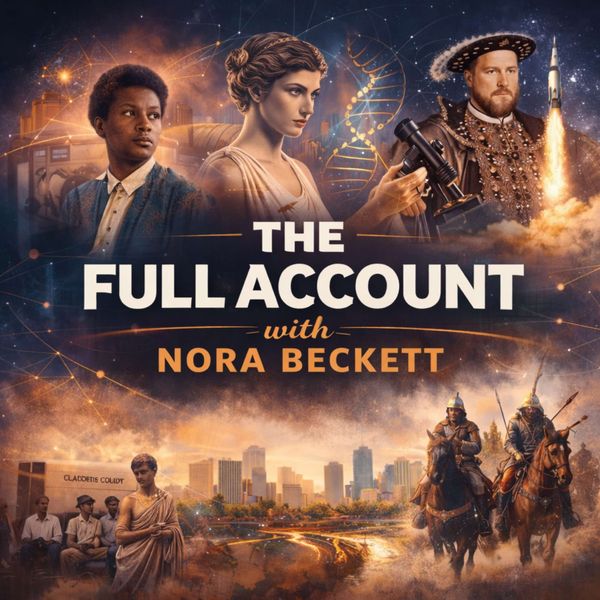
The Full Account
The Siege of Carthage — Complete Two-Episode Arc (Episodes 016–017)
Nora Beckett tells the story of Carthage the way it deserves to be told — starting inside the city before Rome arrives.
Episode 016: Origins opens not with Hannibal's elephants or Carthago delenda est but with Carthage as a Phoenician commercial civilization that dominated the western Mediterranean for centuries. A city of perhaps 700,000 at its height. A constitution Aristotle studied and admired. Trade routes reaching Britain for tin and sub-Saharan Africa for gold. Nora establishes this with the specificity the subject demands — and then names the historiographical problem that runs through everything: Carthage's own records did not survive its destruction. Almost everything known about Punic culture, religion, and governance comes from the accounts of rivals and conquerors. The episode then traces the political machinery that produced the Third Punic War with documentary precision: Cato the Elder's obsessive campaign, the economic interests of Roman merchants who wanted Carthaginian competition eliminated, and the specific sequence of demands in 149 BCE — hostages, arms surrender, and finally the demand to abandon the city itself — calibrated not to be accepted but to manufacture a pretext for war the Romans had already decided to fight. The siege runs three years. The burning runs seventeen days. The episode closes in 146 BCE, in the silence where Carthage had stood, and frames the territory ahead: what was lost when the city's own records burned with everything else.
Episode 017: Aftermath brings Lenz Gupta to the table as a classical historian and Phoenician/Punic studies specialist, and the examination shifts from the military narrative to what the destruction cost the historical record. Mago's agricultural treatise — the single Carthaginian work the Roman Senate ordered preserved in Latin translation — is examined as evidence of the scope of what was not preserved. The tophet controversy receives the scholarly care it demands: both readings of the excavated precinct's cremated remains presented honestly, what the physical record can and cannot establish named without false resolution. Carthaginian religion — Tanit, Baal Hammon — is addressed as a system reconstructed almost entirely from the descriptions of people who destroyed it, and the methodological distortion this introduces is treated as a finding rather than a caveat. The persistence of the Punic language into late antiquity — Augustine still encountering Punic speakers in the fourth century CE — surfaces as evidence of the limits of even deliberate erasure. The series closes where it should: not on the military outcome but on the decision itself. Not an inevitable consequence of warfare but a political choice, made by named Roman actors for documented reasons, that determined what subsequent centuries would and would not know about one of the ancient world's great civilizations. The compressed version is the Roman version. The full account includes the silence where Carthage's own version should have been.
The Gable Standard
Episode 015: Public Square — Free Speech on Campus
Merritt Gable opens the phone lines and builds the foundationalist case through five structured caller interactions, each advancing a distinct dimension of what she argues is the university's self-betrayal.
The framing is precise: the university possesses a singular legitimating principle — the pursuit of truth through unfettered inquiry — and every mechanism that chills speech, from formal codes to informal cultures of self-censorship, constitutes a betrayal of that principle. The episode works through the full spectrum of the debate. Mauro, an undergraduate, provides the concrete institutional reality of speech code enforcement: a disciplinary action for an expressed classroom opinion. Taksh, a tenured professor, documents the invisible cost — views unpublished, research topics avoided, students who have learned which answers invite professional risk. Ate Lyn, a university administrator, makes the genuine institutional case: real obligations to all community members, hostile environments that demonstrably impede learning, bias response teams that exist because students reported real harm. Merritt steelmans this position fully before arguing that the mechanism fails the goal — that speech codes undermine the inclusion they claim to serve because genuine inclusion requires the freedom to challenge, disagree, and hold unpopular positions. Adam Rivers presents the absolutist case and is pushed back: Merritt draws the line between academic freedom and First Amendment absolutism, defending institutional standards of evidence and scholarly rigor as legitimate constraints that protect inquiry rather than suppress it. Jon brings specific pragmatic reforms; Merritt evaluates each against the foundationalist standard.
The synthesis includes specific prescriptions: eliminate bias response systems that function as speech-chilling mechanisms, restore viewpoint diversity as an explicit institutional value, enforce existing anti-harassment law rather than expanding speech codes, rebuild faculty culture of intellectual courage. And Merritt acknowledges where conservative governance and conservative campus movements have contributed to the problem — the meritocratic standard applies to all positions, including her own.
On What Planet
The Radium Girls — Complete Three-Episode Arc (Episodes 020–022)
The show's three-persona panel — the Reality Check, the Forensic Auditor, and the Exhausted Curmudgeon — work through a three-part catalog of institutional failure that begins with a factory in New Jersey and ends with a spreadsheet that calculated human lives as a line item.
Episode 020: Personal Suppression establishes the foundational pattern with the Radium Girls case. US Radium Corporation instructed dial painters to lip-point radium-laden brushes — shaping their brushes by drawing them between their lips, as instructed — while its own physicians documented the exposure pathway internally and said nothing to the workers. Company chemists and management used lead screens and tongs. The Auditor reconstructs the evidentiary timeline with clinical precision: when the first dial painters fell ill, when internal medical evidence was generated, what the workers were told. The Cynic files the first catalog entry: company doctors, company science, company silence. The host delivers the root cause — employer-controlled occupational health evidence — and the actionable lesson: occupational health data must be reported to an authority independent of the employer.
Episode 021: Civilizational-Scale Suppression escalates to the leaded gasoline campaign. GM, Standard Oil, and DuPont promoted tetraethyl lead as a gasoline additive from 1923 while suppressing Clair Patterson's research on lead toxicity — not through silence but through something more sophisticated: industry-funded counter-research designed to produce ambiguity rather than knowledge. The Auditor documents Patterson's timeline, the Kehoe paradigm of "natural levels," the industry's response to his 1965 paper establishing the anthropogenic origin of ambient lead through ice core analysis. The response was not to address the data but to remove Patterson from advisory panels, pressure his funding sources, and manufacture enough doubt to prevent regulatory action for nearly a decade. The Cynic files the second catalog entry and names the template: this is the first fully documented case of industry-funded doubt manufacturing as a regulatory delay strategy — the architecture that tobacco, asbestos, and fossil fuel industries would later adopt. The host delivers the root cause: regulatory capture. The Northern Hemisphere's ice record carries the lead signal.
Episode 022: Explicit Monetization of Known Harm completes the arc. The Ford Pinto fuel tank decision does not suppress or bury — it calculates. Ford engineers identified that the rear-mounted fuel tank would rupture in rear-end collisions above approximately 25 mph and identified fixes costing between $5.08 and $11 per vehicle. The cost-benefit memo compared the total fix cost across 12.5 million vehicles ($137 million) against projected wrongful death and injury settlements ($49.5 million) and concluded the deaths were the cheaper option. The Auditor presents the arithmetic without editorial comment — the document speaks. The Cynic closes the three-entry catalog and names the progression that holds across all three episodes: suppress the evidence, bury the science, write the memo. Each step is more explicit than the last. The host delivers the arc synthesis: every decision was rational within its incentive system, and that is the failure mode. The liability framework that made settlements cheaper than prevention is the root cause. When the cost-benefit analysis concludes that deaths are the economical choice, the legal framework that produced that conclusion is what must change.
Stone Ground Reality
The Intelligence Apparatus — Complete Five-Episode Arc (Episodes 042–046)
This is the most architecturally ambitious series in the current portfolio — five episodes, a custom accountability arc, and a question that doesn't resolve cleanly because it isn't meant to: can secret government be democratically accountable?
Episode 042: The Secret State is the foundational exposure monologue. Thatcher Stone opens the case file — not as a conspiracy theorist but as a citizen who has read the declassified record and is reporting what it says. The intelligence community's structure: 17 agencies, classified budgets in the hundreds of billions, an operational scope largely hidden from both Congress and the public. The documented record of abuse: COINTELPRO's fifteen-year campaign targeting domestic political movements (Church Committee findings, declassified FBI memoranda); NSA warrantless surveillance programs from the 1970s through the 2013 bulk metadata disclosures; CIA-orchestrated regime changes in Iran, Guatemala, and Chile; the torture program documented in the Senate Intelligence Committee's 2014 study; and specific named instances of senior intelligence officials lying to Congress — DNI Clapper's false testimony on bulk collection, CIA Director Brennan's false denial of accessing Senate committee computers. The episode acknowledges that intelligence agencies perform necessary functions, addresses the strongest counterarguments — the national security necessity defense, the bad apples claim, the argument that abuses were products of their time and have been corrected — and closes with the accountability question that drives the remaining four episodes: if these abuses occurred while oversight mechanisms were in place, what does oversight actually do?
Episode 043: Oversight Theater answers that question with Merritt Gable as guest, applying her Burkean institutional analysis to the specific mechanisms of oversight failure. The diagnosis is institutional capture across every node. Congressional intelligence committees co-opted through information asymmetry and career incentives — classification prevents public discussion of what members learn in closed briefings, and members who challenge agencies risk losing access. The FISA court approving warrant applications at rates historically below one percent denial, hearing only the government's case without adversarial process — Judge Rosemary Collyer's 2017 opinion rebuking the NSA for systematic noncompliance cited as evidence that the court itself knows it's being misled. Inspectors general classified, slow-walked, and dependent on the agencies they audit. Whistleblowers — Thomas Drake, John Kiriakou, Edward Snowden — prosecuted under the Espionage Act for exposing what the oversight apparatus failed to catch. The Five Eyes comparison: Australia's Inspector-General of Intelligence and Security, structurally independent with statutory access, producing measurably different constraint. The bipartisan accounting: Gable holds Republicans to account for expanded surveillance authorities and torture program authorization; Thatcher holds Democrats to account for record whistleblower prosecutions and normalization of bulk collection. Both positions earn their place in the same episode. The episode closes with Gable's prescription for genuine accountability and Thatcher's bridge to Episode 3.
Episode 044: Domestic Surveillance brings Julian Verran to examine the Fourth Amendment void — what happens when the same agencies operating under those same broken oversight mechanisms turn their collection capabilities inward. The post-9/11 legislative expansion traced specifically: PATRIOT Act, Protect America Act, FISA Amendments Act, successive reauthorizations making emergency authorities permanent. Section 702's backdoor search loophole — authorized for foreign targets, sweeping up Americans' communications, then queried using American identifiers without individual warrants — examined as a mechanism that defeats Fourth Amendment protection at both the collection and search stages through procedural architecture. The data-purchasing workaround receives sustained attention as the episode's sharpest analytical exhibit: agencies purchasing location data, browsing records, and digital profiles from commercial brokers — information that would require a court order to collect through surveillance — while arguing the purchase is a commercial transaction. The Supreme Court's Carpenter decision requiring warrants for cell-site location data nullified by routing acquisition through a data broker. Fusion centers extending federal surveillance capability into local policing without applicable oversight constraints. Verran's who-bears-the-cost analysis: Muslim American communities monitored through community mapping programs, communities of color targeted by predictive policing feedback loops, journalists and activists swept into intelligence databases. Genuine tension emerges between Thatcher's institutional optimism on reform capacity and Verran's structural skepticism — and neither resolves it, because neither should.
Episode 045: Who Benefits is the convergence episode — the one where conservative foundationalism and progressive structural analysis arrive at the same diagnosis through different frameworks. Both guests, Gable and Verran together, anchored by Eisenhower's 1961 farewell address: a five-star general warning about the complex he helped build, and the warning being ignored. The financial architecture documented: intelligence budgets exceeding $100 billion annually, the majority classified; the defense-intelligence contractor ecosystem (Lockheed Martin, RTX, Northrop Grumman, Boeing, General Dynamics, Booz Allen Hamilton, SAIC, Leidos); the revolving door with specific documented personnel movements — DNI Clapper to Booz Allen Hamilton, CIA Director Hayden to the Chertoff Group, NSA Director Alexander founding IronNet Cybersecurity. The think tank ecosystem producing threat assessments that justify the budgets sustaining the industry. Threat inflation as a business model — the Iraq WMD failure as the paradigm case. The bipartisan protection documented without partisan softening on either side. The diagnostic convergence: Gable calls the revolving door meritocratic corruption; Verran calls it structural extraction. Both hold. The remedy divergence is genuine and treated as such — Gable prescribes institutional restoration, Verran prescribes structural redesign, and Thatcher surfaces the honest disagreement without forcing resolution.
Episode 046: The Democratic Question closes the series with the most philosophically demanding argument Thatcher has made across five episodes of production. The monologue stress-tests the fundamental tension — whether the logic of secrecy inherently escapes the logic of democratic accountability — by taking both sides seriously before working toward a conditional answer. Thatcher acknowledges the legitimate case for intelligence secrecy without qualification: sources whose lives depend on anonymity, methods whose effectiveness depends on adversary ignorance, active operations, foreign liaison relationships. He then distinguishes that legitimate secrecy from what classification currently conceals: policy decisions, legal interpretations, budget details, performance metrics, and institutional failures. The episode includes a rare moment of public intellectual honesty: Thatcher entered this series with institutional optimism — his stated position in Episode 3's exchange with Verran was that the constitutional framework provides the tools if political will is exercised. Four episodes of evidence later, he modifies that position. The tools exist within a system designed to prevent their use. Reform requires structural change to create the conditions where political will can operate, not just the exercise of will within the current architecture. The specific reform prescriptions are grounded in historical and comparative precedent: independent oversight bodies modeled on Australia's IGIS, presumption of declassification after defined periods, warrant requirements closing the data-purchasing workaround, whistleblower protections insulated from Espionage Act prosecution, inspector general independence through appointment reform, classification abuse accountability with real consequences. The citizen accountability checklist is concrete: specific committees to contact, specific questions to ask, specific legislation to support, specific organizations doing the legal work, specific moments when citizen engagement matters. The show's closing statement — The rule of law only survives when citizens defend it — lands as the capstone of a five-episode investigation rather than a formulaic sign-off.
The Verran Vector
Episode 015: Public Forum — Student Debt and Higher Ed
Julian Verran opens the phone lines on the $1.7 trillion student debt crisis with a deliberate analytical reframe: away from forgiveness — who gets relief — and toward production — why does college cost this much, and who should pay?
Five callers build the case cumulatively. Gaurav describes $80,000 in debt from a state university degree in communications and a retail management job that requires the degree but can't comfortably service it — the lived reality of credential inflation, where degrees have become mandatory for economic participation without the wages to support their cost. Artem graduated debt-free because his parents could write the checks; watching friends with identical degrees and identical GPAs diverge economically based solely on family wealth gives him a structural analysis that frames the system as a wealth transmission mechanism. Putri is working full-time while attending community college part-time, representing the majority of American higher education students the debate consistently forgets — the ones for whom access is a daily negotiation between work and school rather than a question of admission to a selective institution. Henry, a skilled tradesman who didn't attend a four-year college, makes the principled fairness argument against broad forgiveness — and is engaged seriously, not set up. Julian's response is structural: the fairness concern is legitimate and is precisely why the debate must move to the production side; forgiveness without addressing why costs are so high generates the same debt again next year. Ian, an education policy analyst, delivers the reform prescription: restore state funding with tuition caps tied to funding levels, implement income-contingent repayment modeled on Australia's HECS system, regulate predatory for-profit colleges aggressively, expand credential alternatives. The comparison to Germany, the UK, and the Nordic countries is used as policy evidence, not utopian aspiration. The synthesis reframes the question entirely: higher education is economic infrastructure. We don't ask individuals to privately finance the highway system. The question is whether the institutions that produce the workforce deserve the same treatment.
The Marrow of Truth
Episode 019: Your Call: Fluoride
Virgil Marrow opens the phone lines to hear from listeners who have gone fluoride-free, and the episode functions as intended: a four-caller masterclass in the application of confirmation bias to live testimony.
Darnell has spent thousands on water filtration and feels sharper, lighter, and more awake. Virgil treats this as clinical proof of cognitive liberation. Gaurav's family switched to well water; his children seem healthier, his wife has more energy, and his golden retriever seems noticeably more alert. Virgil latches onto the dog immediately and does not let go — an organism incapable of experiencing placebo effect, he explains, making the retriever the most scientifically rigorous data point in the entire episode. Nichalia asks whether sparkling water is safe. This is the episode's sole moment of genuine Virgil uncertainty, expressed through his framework: carbonation may be a delivery mechanism, or it may disrupt the fluoride substrate — he recommends flat filtered water until the carbonation question can be properly researched. Ranbir is a municipal water treatment plant operator who calls in to calmly explain testing protocols, independent monitoring, regulatory standards, and safety margins. Virgil identifies him as a government employee and thanks him for confirming on air that the program exists, that trained personnel maintain it, and that the government monitors the dosage. Dana Poole interjects once to note the actual regulatory purpose of community water fluoridation. Virgil thanks her for the update. She does not speak again.
Closing Note
Twenty-eight episodes across eight shows. Two arcs that open and close within the same deployment window. One that spans five episodes and never fully resolves the question it raises — because the question is genuinely hard. An author's verdict that holds two irreconcilable findings without splitting the difference. Satire that earns its absurdity by staying one degree of seriousness ahead of its target.
This is what the portfolio is for. Not any single show, not any single voice, not any single political register — but the argument the whole thing makes together: that the quality of an idea is independent of the identity of whoever is expressing it, and that the work of taking ideas seriously is worth doing carefully, at scale, without waiting for the resources or permission that may never arrive.
Everything is in distribution. All free episodes are available on Apple Podcasts without registration. Premium content at genthosmedia.com.
If the work is worth your time, the most useful thing you can do is share it with someone for whom it would also be worth theirs.